Bobotov Kuk
🏔️ Overview
Bobotov Kuk is the highest peak of the Durmitor massif in northwestern Montenegro and one of the most recognizable mountains in the Dinaric Alps. Rising to approximately 2,523 meters (8,278 feet), the mountain forms a rugged limestone pyramid surrounded by glacial basins, alpine meadows, rocky ridges, and some of Montenegro’s most dramatic high-mountain scenery.
The peak stands within Durmitor National Park, a UNESCO World Heritage Site celebrated for its limestone mountains, glacial lakes, deep river canyons, forests, and exceptional biodiversity. Bobotov Kuk is both the park’s highest summit and one of its classic hiking objectives.
Bobotov Kuk was traditionally described as the highest mountain in Montenegro. Modern measurements, however, identify several slightly higher summits along Montenegro’s border with Albania. It is therefore more accurately described as the highest mountain in the Durmitor range and the highest major summit located entirely within Montenegro. Peak databases generally rank it fourth by elevation among peaks associated with Montenegro.
⚡ Fast Facts
| Fact | Details |
|---|---|
| Continent | Europe |
| Country | Montenegro |
| State/Province | Žabljak Municipality |
| County/Region | Durmitor National Park |
| Range | Dinaric Alps / Durmitor |
| Parent Peak | Maja e Jezercës |
| Elevation | Approximately 8,278 ft / 2,523 m |
| Prominence | Approximately 4,846 ft / 1,477 m |
| Isolation | Approximately 57.63 mi / 92.75 km |
| NHN | Maja E Shnikut |
| Coordinates | Approximately 43.1292° N, 19.0338° E |
| Mountain Type | Limestone / karst mountain |
| Protected Area | Durmitor National Park |
| UNESCO Status | Durmitor National Park World Heritage Site |
| First Recorded Ascent | 1883 |
| First Recorded Climber | Oscar Baumann |
Peakbagger lists Bobotov Kuk at 2,522 meters, with 1,477 meters of prominence and approximately 92.75 kilometers of isolation. Other widely used sources and Montenegro’s national tourism organization give the rounded elevation as 2,523 meters.
📍 Location
Bobotov Kuk lies near the center of the Durmitor massif in northwestern Montenegro, within Žabljak Municipality.
The mountain rises southwest of the highland town of Žabljak, the principal tourism and hiking center for Durmitor National Park. Žabljak provides accommodation, restaurants, outdoor services, and access to many of the park’s trailheads.
Bobotov Kuk occupies an especially dramatic part of Durmitor. Nearby peaks include Bezimeni Vrh, Lučin Vrh, Đevojka or Soa, Minin Bogaz, Prutaš, and Šljeme.
Together, Bobotov Kuk, Bezimeni Vrh, and Đevojka form an imposing wall of rock above the Škrka Valley, while the mountain’s southern side towers above the small alpine lake known as Zeleni Vir.
📏 Elevation & Prominence
Bobotov Kuk reaches approximately 2,523 meters (8,278 feet) above sea level.
Peakbagger calculates its topographic prominence at approximately 1,477 meters (4,846 feet). That is exceptionally high relative to its overall elevation and demonstrates just how strongly Durmitor rises above the surrounding landscape.
Its topographic isolation is approximately 92.75 kilometers (57.63 miles). According to Peakbagger, the nearest higher neighbor in its database is Maja E Shnikut, located southeast in the Albanian Alps.
PeakVisor calculates similar but slightly different values, listing about 1,475 meters of prominence and identifying Maja e Jezercës as Bobotov Kuk’s island parent. Differences of a few meters between mountain databases are normal because of varying elevation models and topographic calculation methods.
Is Bobotov Kuk the Highest Mountain in Montenegro?
This question can be surprisingly complicated.
Bobotov Kuk was long considered Montenegro’s highest mountain, and some official tourism material continues to describe it that way. Modern peak databases, however, recognize several higher points along Montenegro’s mountainous border with Albania.
PeakVisor ranks Bobotov Kuk fourth in Montenegro by elevation, although it remains the highest summit of Durmitor and the highest major mountain situated completely within Montenegro rather than on an international border.
🪨 Geology
Bobotov Kuk belongs to the limestone-dominated Dinaric Alps, one of southeastern Europe’s great karst mountain systems.
Durmitor is particularly notable for thick and often dramatically folded limestone formations dating primarily from the Middle and Upper Triassic, Upper Jurassic, and Upper Cretaceous periods. Over millions of years, tectonic uplift, erosion, groundwater dissolution, freeze-thaw weathering, and glaciation transformed these rocks into the rugged landscape visible today.
Karst processes are especially important throughout Durmitor. Rain and snowmelt gradually dissolve soluble limestone, creating:
- Sinkholes
- Caves
- Underground drainage systems
- Rocky depressions
- Limestone pavements
- Steep cliffs and towers
Glaciers later reshaped the massif, excavating broad basins and valleys and leaving behind numerous glacial lakes.
Bobotov Kuk itself has a compact rocky summit pyramid rising above scree slopes and high glacial basins. The surrounding terrain combines jagged limestone cliffs, talus, grassy alpine slopes, and depressions that may retain patches of snow well into summer.
🌿 Flora & Fauna
Durmitor National Park contains an unusually rich mixture of alpine and Mediterranean-influenced ecosystems.
UNESCO reports more than 1,600 vascular plant species in the wider Durmitor massif. Elevation changes of more than 2,000 meters create numerous habitats ranging from river canyons and forests to alpine meadows and nearly barren summit terrain.
Lower elevations support extensive forests, including important stands of European black pine. Higher slopes transition into grasslands, rocky meadows, dwarf vegetation, and eventually bare limestone.
Wildflowers can be particularly impressive during early and midsummer.
Wildlife found within the broader Durmitor ecosystem includes mammals and birds adapted to both forest and mountain environments. The rugged cliffs and remote valleys also provide relatively undisturbed habitat away from the park’s more popular visitor areas.
The summit zone of Bobotov Kuk itself is far harsher. Thin soils, strong winds, snow, exposed limestone, and short growing seasons dramatically limit vegetation as hikers approach the top.
🥾 Hiking & Climbing Routes
Bobotov Kuk is one of Montenegro’s best-known summit hikes, but it should not be mistaken for an easy walk.
Several marked routes lead toward the mountain, eventually converging beneath the final summit pyramid. The upper portion involves steep rocky terrain and exposed scrambling. Cables or other fixed assistance may be encountered on particularly awkward sections.
Sedlo Pass Route
The route from Sedlo Pass is among the most popular ways to climb Bobotov Kuk.
Starting high significantly reduces the total elevation gain compared with hiking all the way from Žabljak.
The trail crosses open alpine terrain before entering increasingly rocky country around the central Durmitor peaks. Routes from the southern side eventually converge near Zeleni Vir before continuing toward the summit.
Depending on the precise route, conditions, and trailhead, a typical Sedlo-area outing may cover roughly 11–13 kilometers and require around six to eight hours.
Žabljak and Black Lake Route
A much longer approach begins near Žabljak and Crno Jezero, or Black Lake.
This is often considered the classic approach to Bobotov Kuk.
Hikers begin among forests and glacial scenery before climbing steadily into the increasingly barren heart of Durmitor. The trail ultimately approaches the summit from the northeast.
The route can require approximately ten hours for a full round trip depending on fitness, conditions, and the exact starting point.
Dobri Do Route
Another southern approach begins around Dobri Do.
It travels through open alpine terrain and eventually joins the other southern routes near Zeleni Vir before the final climb toward Velika Previja and Bobotov Kuk.
Škrka Valley Route
The Škrka approach allows experienced hikers to reach Bobotov Kuk through one of Durmitor’s most spectacular valleys.
The landscape includes steep mountain walls and the beautiful Veliko and Malo Škrčko lakes.
This approach is longer and makes particular sense as part of a larger Durmitor trekking itinerary rather than simply the fastest route to the summit.
Final Summit Ascent
Regardless of approach, the final section becomes substantially more serious.
Loose rock, steep slopes, exposure, scrambling, and changing weather mean hikers should be comfortable moving through mountain terrain. Snowfields can persist into the hiking season, and snow is possible at surprisingly late or early dates.
🏔️ Field Guide Tip: Bobotov Kuk is accessible to experienced hikers in good summer conditions, but the final approach is considerably more exposed than an ordinary trail hike. Start early, check the mountain forecast, wear sturdy footwear, and turn around if thunderstorms, heavy fog, snow, or strong winds make the upper mountain unsafe.
🌤️ Best Time to Visit
The main hiking season for Bobotov Kuk generally runs from June through September.
July and August usually provide the most dependable snow-free access, although lingering snow may remain in sheltered basins and gullies.
June can bring spectacular wildflowers but also residual snow at higher elevations. September often offers cooler temperatures, quieter trails, and beautiful mountain light, although shorter days and early-season snowfall become increasingly possible.
Durmitor’s high terrain can experience rapid weather changes even in summer. Afternoon clouds and showers are common, making an early start particularly valuable. Snow is possible outside the normal winter season.
Winter ascents are substantially more serious and require appropriate snow, avalanche, navigation, and mountaineering skills.
🧭 Nearby Mountains & Attractions
Bezimeni Vrh
Bezimeni Vrh, meaning “Nameless Peak,” rises immediately northwest of Bobotov Kuk to approximately 2,487 meters.
Although slightly lower, it contributes to the enormous wall of rock surrounding the Škrka Valley.
Šljeme
Šljeme reaches approximately 2,455 meters and is another of Durmitor’s major high summits.
Its position east of Bobotov Kuk adds to the spectacular concentration of high mountains in the center of the massif.
Prutaš
Prutaš is one of Durmitor’s most visually distinctive mountains.
Its striped limestone formations and grassy slopes make it a particularly popular hiking and photography destination.
Zeleni Vir
Zeleni Vir is a small high-altitude lake beneath Bobotov Kuk.
Several southern approaches to the mountain converge near the lake before beginning the steeper final stage toward the summit.
Black Lake
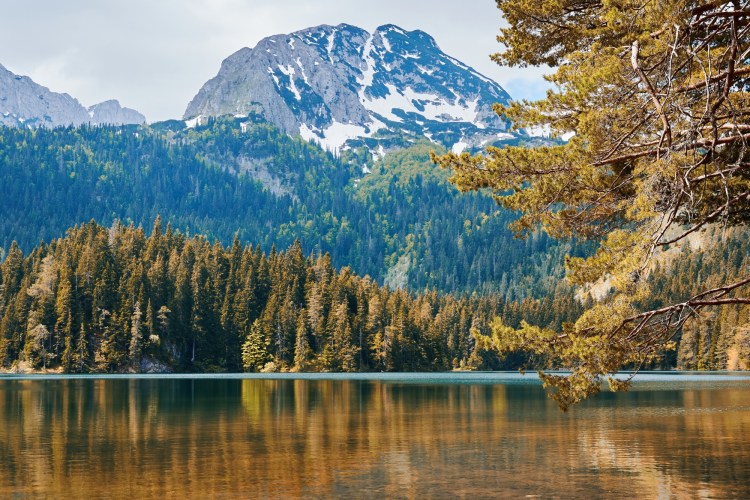
Crno Jezero, or Black Lake, is one of the best-known attractions in Durmitor National Park.
Located close to Žabljak, it is surrounded by forest and towering mountain scenery and provides access to several hiking routes into the massif.
Tara River Canyon
The Tara River Canyon forms one of Durmitor National Park’s most celebrated landscapes.
UNESCO identifies the Tara gorge as one of the deepest canyon systems in Europe, with dense forests and remarkably clear river waters complementing the surrounding mountain scenery.
Durmitor National Park
The national park protects roughly 39,000 hectares and contains 48 peaks exceeding 2,000 meters along with numerous glacial lakes.
Durmitor became a national park in 1952 and was inscribed on UNESCO’s World Heritage List in 1980.
💡 Fun Facts
- Bobotov Kuk is the highest peak in the Durmitor massif.
- Its summit reaches approximately 2,523 meters.
- It has roughly 1,477 meters of topographic prominence.
- The mountain is isolated from higher terrain by more than 92 kilometers.
- Bobotov Kuk was historically regarded as Montenegro’s highest mountain.
- Modern measurements identify several slightly higher border peaks.
- The mountain lies entirely within Durmitor National Park.
- Durmitor National Park is a UNESCO World Heritage Site.
- The first recorded ascent of Bobotov Kuk occurred in 1883.
- Austrian cartographer Oscar Baumann is credited with that ascent.
- Bobotov Kuk, Bezimeni Vrh, and Đevojka form an enormous rocky amphitheater above the Škrka Valley.
- Numerous hiking approaches allow visitors to experience dramatically different sides of the mountain.
- The high Durmitor landscape was heavily shaped by ancient glaciers.
- Limestone and karst landforms dominate the geology.
- From the summit, clear weather can reveal an enormous portion of Montenegro and mountain ranges extending into neighboring Balkan countries.
❓ FAQ
How high is Bobotov Kuk?
Bobotov Kuk reaches approximately 2,523 meters (8,278 feet) above sea level. Peakbagger gives a slightly different figure of 2,522 meters.
Where is Bobotov Kuk?
Bobotov Kuk is located in Durmitor National Park in northwestern Montenegro, southwest of the mountain town of Žabljak.
Is Bobotov Kuk the highest mountain in Montenegro?
It is the highest mountain in the Durmitor massif and one of Montenegro’s most important summits. It was historically regarded as the country’s highest mountain, but modern measurements recognize several slightly higher peaks on Montenegro’s border with Albania.
What is Bobotov Kuk’s prominence?
Peakbagger lists approximately 1,477 meters (4,846 feet) of topographic prominence.
What is Bobotov Kuk’s nearest higher neighbor?
Peakbagger identifies Maja E Shnikut, in the Albanian Alps, as the nearest higher neighbor. The higher terrain lies approximately 92.75 kilometers southeast of Bobotov Kuk.
Can you hike Bobotov Kuk?
Yes. Bobotov Kuk has several established hiking routes, including approaches from Sedlo Pass, Žabljak, Dobri Do, and the Škrka Valley.
However, the summit hike is strenuous and includes steep, rocky, exposed terrain. It is best suited to fit hikers who are comfortable with mountain scrambling.
How long does it take to climb Bobotov Kuk?
The popular approach from the Sedlo area commonly takes around six to eight hours, depending on the exact route and hiking speed.
The longer traditional approach from the Žabljak or Black Lake area can require approximately ten hours for the round trip.
When is the best time to climb Bobotov Kuk?
The most reliable hiking period is generally June through September, with July and August offering the greatest chance of snow-free conditions.
Is Bobotov Kuk inside a national park?
Yes. Bobotov Kuk stands within Durmitor National Park, one of Montenegro’s most important protected landscapes and a UNESCO World Heritage Site.
🔗 Related Articles
- Mount Jezerce
- Maja E Shnikut
- Maja E Radohimes
- Mount Maglic
- Dinaric Alps
- The World’s Top 100 Mountain Ranges
📚 Sources
- Peakbagger — Bobotov Kuk
- UNESCO World Heritage Centre — Durmitor National Park
- Montenegro National Tourism Organisation — Durmitor National Park
- SummitPost — Bobotov Kuk
- PeakVisor — Bobotov Kuk