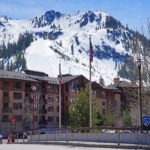
Mont Maudit

Rising between Mont Blanc du Tacul and Mont Blanc, Mont Maudit is one of the highest and most consequential summits in the Mont Blanc massif. Its broad northern snowfields form part of the celebrated Trois Monts route to Mont Blanc, while the mountain’s southern side drops away in much steeper rock, ice, and mixed terrain toward Italy’s Aosta Valley.
At approximately 4,465 meters (14,649 feet), Mont Maudit is a major Alpine 4,000er in its own right. Yet many climbers encounter it not as an isolated objective but as the central mountain in the high-altitude passage from the Aiguille du Midi toward Mont Blanc. The standard Trois Monts itinerary usually crosses Mont Maudit’s upper slopes and the Col du Mont Maudit without necessarily visiting the true summit, which requires an additional ascent.
The mountain’s French name means “Cursed Mountain.” That dramatic title predates modern climbing and reflects an older period when much of the high Mont Blanc region was collectively associated with the Montagne Maudite. Today, Mont Maudit remains a fittingly serious mountain, famous for the elegant Kuffner Ridge, extensive glaciers, avalanche exposure, and one of the most important mountaineering corridors in the Alps.
⚡ Fast Facts
| Feature | Details |
|---|---|
| Mountain | Mont Maudit |
| Meaning of Name | “Cursed Mountain” |
| Countries | France and Italy |
| French Region | Auvergne-Rhône-Alpes |
| French Department | Haute-Savoie |
| Italian Region | Aosta Valley |
| Mountain Range | Mont Blanc massif, Graian Alps |
| Elevation | 14,649 feet / 4,465 meters |
| Prominence | Approximately 507 feet / 154 meters |
| Isolation | Approximately 0.71 miles / 1.14 kilometers |
| Nearest Higher Neighbor | Mont Blanc |
| Key Saddle | Col de la Brenva |
| Key Saddle Elevation | Approximately 14,142 feet / 4,311 meters |
| Rock Type | Primarily granite and associated crystalline rocks |
| First Ascent | September 12, 1878 |
| First Ascenders | H. Seymour Hoare, W. E. Davidson, Johann Jaun, and Johann von Bergen |
| Easiest Summit Route | North face / northwest ridge |
| Typical Normal Grade | Around PD to PD+ depending on conditions |
| Classic Technical Route | Kuffner Ridge |
| Kuffner Ridge Grade | Approximately D |
| Principal French Base | Refuge des Cosmiques |
| Major Nearby Pass | Col du Mont Maudit |
| Col du Mont Maudit Elevation | Approximately 4,345 meters |
| Major Glacial Terrain | Glacier du Géant, Col Maudit basin, Brenva Glacier system |
| Best Known For | Trois Monts route, Kuffner Ridge, steep glacial terrain, and avalanche history |
Modern lidar measurements give Mont Maudit an elevation of approximately 4,465 meters and about 154 meters of prominence. Its relative lack of prominence reflects its close connection with the much larger summit mass of Mont Blanc.
🏔️ Where Is Mont Maudit?
Mont Maudit stands immediately northeast of Mont Blanc along the high crest separating France’s Haute-Savoie from Italy’s Aosta Valley.
To the northeast is Mont Blanc du Tacul, separated from Mont Maudit by the high glacial basin around Col Maudit. To the southwest, the mountain descends toward the Col de la Brenva, beyond which the enormous summit structure of Mont Blanc begins.
Its northern slopes face the glacial terrain approached from the Aiguille du Midi and Refuge des Cosmiques. This is the side crossed by mountaineers using the famous Trois Monts route.
The southern side is much steeper and more rugged. Granite ridges fall toward the Brenva Glacier and the Italian side of the massif, producing some of Mont Maudit’s finest technical climbing routes.

🌍 A Summit on the France–Italy Border
The summit of Mont Maudit lies directly on the international boundary between France and Italy.
This frontier continues northeast through a spectacular system of aiguilles and ridges toward Dent du Géant and the Grandes Jorasses. In the opposite direction it continues toward the main summit of Mont Blanc.
Water and ice falling on opposite sides of the divide eventually enter entirely different drainage systems. French glaciers ultimately feed waterways flowing toward the Rhône basin, while Italian ice drains toward the Dora Baltea and Po.
The international ridge is therefore both a political border and one of the major watersheds of the Western Alps.
😈 Why Is It Called Mont Maudit?
Mont Maudit translates directly as “Cursed Mountain.”
The name has roots in the older history of the Mont Blanc region. Before the highest summit became universally established as Mont Blanc, names related to Montagne Maudite were applied more broadly to the intimidating snow-covered mountains above the surrounding valleys.
These high peaks were once regarded less as recreational destinations than as threatening and mysterious places associated with glaciers, storms, avalanches, and supernatural stories.
As exploration improved understanding of the massif, Mont Blanc—“White Mountain” became the established name for the highest summit. The older Maudit designation survived on its major northeastern neighbor.
The result is one of the most evocative names in the Alps.
🪨 Geology of Mont Maudit
Mont Maudit forms part of the crystalline core of the Mont Blanc massif and consists primarily of granite and related crystalline rocks.
The Mont Blanc granite formed deep below Earth’s surface when molten material cooled slowly and crystallized. Alpine tectonic uplift later carried this ancient rock upward, while erosion removed the material that once covered it.
Glaciation then profoundly reshaped the landscape.
Ice repeatedly flowed around Mont Maudit during colder climatic periods, excavating basins and valleys while exposing resistant ridges. The mountain’s northern side became dominated by snowfields and glaciers, while its southern aspect retained much steeper rock walls and ridges.
Freeze-thaw cycles continue to fracture exposed rock. As snow, glacier ice, and high-elevation permafrost change, previously frozen sections can become less stable, making rockfall another consideration on mixed routes.

📜 The First Ascent
The first generally accepted ascent of Mont Maudit took place on September 12, 1878.
British climbers H. Seymour Hoare and W. E. Davidson were accompanied by Swiss guides Johann Jaun and Johann von Bergen.
The party spent the previous night at the Grands Mulets before setting out at approximately 1:50 in the morning. Rather than climbing Mont Maudit by the modern northern approach, they traveled through the high Mont Blanc glacier system and reached the Col de la Brenva.
From there they climbed the south ridge to the summit.
Historical accounts describe considerable care near an enormous cornice overhanging the Brenva Glacier, although the final ascent itself proved less difficult than expected.
The team reached the summit at approximately 8:15 in the morning before continuing toward Mont Blanc.
🧐 Was Mont Maudit Climbed Before 1878?
The early history of Mont Maudit contains an intriguing uncertainty.
Some 19th-century parties traveling between the Col du Midi and Mont Blanc claimed to have reached or crossed high points associated with Mont Maudit well before 1878. In particular, accounts from an expedition in 1855 later suggested that climbers may have passed over both Mont Blanc du Tacul and Mont Maudit.
The exact terrain reached by those parties is difficult to reconstruct.
Hoare and Davidson regarded their 1878 climb as the first true ascent of the actual summit, and contemporary Alpine records generally recognized their claim.
This type of ambiguity is not unusual in early mountaineering history. Before accurate maps and detailed summit measurements, climbers sometimes reached high shoulders or subsidiary tops without being certain whether they had stood on the true highest point.
🧗 The Normal Route
The easiest established summit route approaches Mont Maudit from the north, usually beginning at Refuge des Cosmiques.
Climbers descend onto the glacier near the Col du Midi and cross beneath or over the shoulder of Mont Blanc du Tacul.
After descending toward Col Maudit, the route climbs the northern slopes of Mont Maudit.
This terrain contains crevasses, steep snow and ice, bergschrunds, and areas exposed to seracs and avalanches.
The climber seeking Mont Maudit itself then leaves the standard Mont Blanc traverse and continues toward the true summit, generally gaining the upper northwest ridge.
Although the easiest route is often graded around PD or PD+, the grade can vary considerably with conditions.

🏔️ The Trois Monts Route
Mont Maudit is perhaps best known as the central mountain on the Trois Monts, or Three Mountains, route to Mont Blanc.
The journey begins near the Aiguille du Midi and Refuge des Cosmiques. Climbers first cross the glaciated northern side of Mont Blanc du Tacul before descending toward Col Maudit.
They then climb the steep northern slopes of Mont Maudit toward the Col du Mont Maudit, situated at approximately 4,345 meters.
From this high pass, the route descends toward the Col de la Brenva before beginning the final ascent toward Mont Blanc.
Despite the name, parties following the normal Trois Monts line commonly bypass the true summits of Mont Blanc du Tacul and Mont Maudit. The itinerary traverses their high slopes rather than requiring the climbers to stand on each summit.
🧊 Col Maudit and Col du Mont Maudit
Two similarly named passes can cause confusion.
Col Maudit, at roughly 4,035 meters, lies between Mont Blanc du Tacul and Mont Maudit.
From this lower glacial basin, climbers begin the major ascent of Mont Maudit’s northern slopes.
The Col du Mont Maudit, by contrast, lies much higher at approximately 4,345 meters near the upper western shoulder of the mountain.
The climb between these two areas is one of the principal technical sections of the Trois Monts route.
Depending on conditions, the final slope beneath the upper col can involve steep snow or hard ice approaching roughly 50 degrees. Bergschrunds and changing glacier formations can make the precise line substantially different from one season to another.
🛖 Refuge des Cosmiques
Refuge des Cosmiques, at approximately 3,613 meters, is the principal base for Mont Maudit from the French side.
The hut sits near the Col du Midi beneath the Aiguille du Midi.
Its accessibility is unusual for such a high refuge because mountaineers can use the Aiguille du Midi cable car from Chamonix before descending the exposed snow ridge and crossing the glacier to the hut.
That convenience should not obscure the seriousness of the surrounding environment.
The moment visitors leave the developed Aiguille du Midi station, they enter high-altitude glacier terrain requiring appropriate equipment and mountaineering experience.
From the Cosmiques, climbers commonly attempt Mont Blanc du Tacul, Mont Maudit, the Trois Monts route, the Cosmiques Arête, and numerous technical climbs in the surrounding basin.
🧗♂️ The Kuffner Ridge
The most celebrated technical route on Mont Maudit is the Kuffner Ridge, also known as the Southeast Ridge or Frontier Ridge.
It is one of the classic mixed ridges of the Mont Blanc massif.
The route follows the sharp international crest rising from the southeastern side of the mountain. Climbers encounter snow arêtes, ice, granite, exposed gendarmes, and highly scenic mixed terrain.
Unlike the broad northern approach, the Kuffner feels consistently narrow and exposed.
It is generally graded around D, placing it well above the difficulty of the normal route.
For experienced alpinists, its combination of technical climbing and elegant position has made it one of the most highly regarded classic routes around Mont Blanc.
📜 The First Ascent of the Kuffner Ridge
The Kuffner Ridge was first climbed from July 2–4, 1887 by Austrian mountaineer Moriz von Kuffner with Swiss guides Alexander Burgener and Josef Furrer.
Burgener was already one of the greatest guides of his generation. His name appears repeatedly in the history of difficult Alpine climbing, including important ascents on Aiguille du Dru and many other peaks.
Their route up Mont Maudit represented the increasing technical ambition of late-19th-century mountaineering.
By the 1880s, simply reaching major summits was no longer the only goal. Climbers were deliberately selecting beautiful and difficult ridges even when easier routes already existed.
The Kuffner Ridge became an outstanding example of this new philosophy.
🏔️ Pointe de l’Androsace
One of the distinctive landmarks on the Kuffner Ridge is the Pointe de l’Androsace.
This rocky gendarme rises along the southeastern crest at more than 4,000 meters and forms one of the characteristic obstacles on the route.
The ridge surrounding it is dramatically exposed, with the French and Italian sides falling away toward separate glacier basins.
Passing the Androsace is part of what gives the Kuffner its character as a genuine mixed ridge rather than simply a snow ascent.
The feature is also a useful visual landmark when examining the southern profile of Mont Maudit from surrounding high viewpoints.
🧊 Col de la Brenva
The Col de la Brenva, at approximately 4,311 meters, separates Mont Maudit from the main summit mass of Mont Blanc.
It is also Mont Maudit’s key col for calculating topographic prominence.
The saddle played an important role in the first ascent of 1878. Hoare, Davidson, Jaun, and von Bergen reached it before climbing Mont Maudit from the south.
Today, the Col de la Brenva remains a major waypoint on the Trois Monts route.
After crossing the upper slopes of Mont Maudit, climbers descend toward the col before beginning the long final rise toward Mont Blanc.
Despite its enormous elevation, the saddle can feel surprisingly broad compared with the rocky ridges elsewhere on Mont Maudit.
🏔️ The Brenva Side
South of Mont Maudit lies the immense Brenva Glacier and some of the wildest terrain in the entire Mont Blanc massif.
The mountain’s southern face is dramatically steeper than its northern slopes. Rock buttresses, hanging snowfields, ice gullies, and mixed ridges descend toward the glacier.
This terrain forms part of the larger Brenva basin below the eastern and southeastern sides of Mont Blanc.
For generations of climbers, the Brenva side has represented the more serious and adventurous face of the massif, far removed in character from the heavily traveled normal route through Goûter.
Mont Maudit’s southern ridges fit perfectly within this landscape.
🗻 The Aiguilles du Diable
Extending from the northeastern side of Mont Maudit is the spectacular Aiguilles du Diable, or “Devil’s Needles.”
This series of rocky towers forms one of the great technical traverses of the Mont Blanc massif.
Several of the individual aiguilles exceed 4,000 meters, and the complete traverse involves sustained granite climbing at extreme altitude before ultimately reaching Mont Maudit.
Their jagged appearance contrasts sharply with the mountain’s broad snowy northern slopes.
Together, Mont Maudit and the Aiguilles du Diable illustrate the extraordinary variety of the massif: glacier terrain on one side and technical granite towers on the other.
❄️ Avalanche Hazard
Avalanche danger is one of the most important objective hazards on Mont Maudit.
Its northern side combines steep snow, seracs, glacier fractures, and terrain regularly crossed by climbers heading toward Mont Blanc.
The risk is not theoretical.
On July 12, 2012, an avalanche struck climbers on Mont Maudit during an early-morning ascent. Nine people were killed and nine others were injured, making it one of the most serious Alpine mountaineering accidents of that period.
The tragedy reinforced an important lesson about high mountains: a route can be frequently climbed and still carry substantial objective risk.
Popularity should never be confused with safety.

🧊 Seracs and Crevasses
The northern approach to Mont Maudit crosses a dynamic glacier environment.
Seracs—large towers or blocks of glacier ice—can collapse without warning. Because their failure is controlled partly by glacier movement rather than simply immediate weather conditions, avoiding exposure is often more important than attempting to predict the exact moment of collapse.
Crevasses present another major challenge.
Snow bridges may conceal deep openings, particularly earlier in the season. Later, those bridges weaken and larger cracks become exposed.
Bergschrunds near steep slopes can dramatically alter route difficulty and may force climbers onto steeper or more complicated terrain.
For this reason, recent local route information is essential.
⚠️ Hazards and Safety
Mont Maudit should be considered a serious high-altitude mountaineering objective even by experienced climbers.
The hazards include avalanches, serac collapse, crevasses, bergschrunds, hard ice, rockfall, cornices, storms, high winds, whiteouts, extreme cold, and altitude illness.
The Trois Monts route can create an additional psychological trap because many climbers think primarily of their goal as Mont Blanc. Mont Maudit may be viewed simply as an obstacle along the way.
In reality, the Maudit section contains some of the route’s most technical and objectively dangerous terrain.
At elevations above 4,000 meters, fatigue and reduced oxygen can also affect judgment and climbing efficiency.
Mountaineers should be prepared to turn around when glacier, snow, weather, or avalanche conditions are unfavorable.
🌡️ A Rapidly Changing Route
Climate change is altering routes throughout the Mont Blanc massif, and Mont Maudit is no exception.
Warmer conditions affect snow accumulation, glacier thickness, crevasse development, bergschrunds, and the stability of steep mixed terrain.
A passage that once offered continuous snow may later expose hard ice. A bergschrund can become substantially wider, while newly exposed rock may increase falling-stone hazards.
Serac configurations also change as glaciers flow and thin.
Historical guidebooks remain valuable for understanding the mountain, but they cannot replace current route information.
Conditions on Mont Maudit should always be evaluated as they exist now rather than as they appeared to previous generations.
🎿 Ski Mountaineering
Mont Maudit also attracts highly experienced ski mountaineers.
The broad glacial terrain surrounding the northern side can form part of major ski traverses through the high Mont Blanc massif.
Under suitable conditions, ski mountaineers may travel through the Col Maudit area or combine parts of the Trois Monts terrain with other descents.
The steepest summit and couloir routes belong to the extreme end of ski mountaineering.
Crevasses, avalanche exposure, seracs, hard ice, altitude, and rapidly changing snow conditions make these objectives far removed from conventional ski touring.

🌿 Flora and Fauna
At 4,465 meters, Mont Maudit lies deep within the nival zone, where conditions are too severe for conventional plant communities.
The upper mountain consists almost entirely of glacier ice, snow, exposed granite, and extremely cold, wind-scoured terrain.
Lichens and microscopic organisms may survive on protected rock surfaces, but vascular vegetation is essentially absent.
Far below, the Chamonix and Courmayeur valleys support much richer Alpine ecosystems. Gentians, saxifrages, bellflowers, rhododendrons, grasses, and alpine clovers grow during the short summer season, while larch and spruce forests occupy lower slopes.
Wildlife in the broader region includes Alpine ibex, chamois, marmots, mountain hares, rock ptarmigan, Alpine choughs, golden eagles, and bearded vultures.
The extreme elevation difference around Mont Maudit creates a transition from productive valley ecosystems to one of the most biologically austere landscapes in Europe.
👀 Where to See Mont Maudit
Mont Maudit can be appreciated without climbing it.
One of the finest viewpoints is the Aiguille du Midi, where visitors can look across the high glacial basin toward Mont Blanc du Tacul, Mont Maudit, and Mont Blanc.
From this direction, the mountain’s snowy northern side is especially prominent.
The Pointe Helbronner area on the Italian side provides another excellent perspective, revealing a more complicated landscape of rock ridges, glaciers, and the nearby Aiguilles du Diable.
Mont Maudit can also be identified from numerous high hiking viewpoints around the Chamonix Valley, particularly from the Aiguilles Rouges.
These perspectives help show how the mountain sits directly between Tacul and Mont Blanc.
🏔️ Nearby Mountains
Mont Maudit stands at the heart of the highest section of the Mont Blanc massif.
Immediately northeast lies Mont Blanc du Tacul, the first major mountain crossed on the Trois Monts route from the Aiguille du Midi.
Southwest is Mont Blanc, Mont Maudit’s nearest higher neighbor and the highest mountain in the Alps.
Farther west, Dôme du Goûter forms part of the great western shoulder of Mont Blanc and the normal Goûter route.
Beyond it is Aiguille de Bionnassay, famous for its knife-edge snow ridges.
To the northeast and east, the massif extends through the Géant sector toward Dent du Géant and the Grandes Jorasses.

🌄 Why Mont Maudit Is Special
Mont Maudit is sometimes overshadowed by Mont Blanc, but it is far more than a subsidiary obstacle on the way to a higher summit.
Its 4,465-meter summit makes it one of the great high mountains of the Alps. Its north side forms a critical part of the Trois Monts route, while its south and southeast ridges provide some of the most beautiful technical climbing in the massif.
Its history stretches from uncertain early crossings to the recognized first ascent of 1878 and the opening of the Kuffner Ridge less than a decade later.
The mountain also demands respect. The avalanche history and continuing hazards from seracs, crevasses, steep ice, and changing glacier conditions demonstrate that a frequently traveled route can remain profoundly serious.
Perhaps that combination explains why the old name feels so enduring. Mont Maudit—the Cursed Mountain—is both magnificent and unforgiving, a high glacial crossroads standing between Mont Blanc du Tacul and the roof of the Alps.

🔗 Related Articles
- Mont Blanc
- Mont Blanc du Tacul
- Dôme du Goûter
- Aiguille de Bionnassay
- Dent du Géant
- Grandes Jorasses
- Tour Ronde
📚 Sources
- Peakbagger — Mont Maudit
- Peakbagger — Col de la Brenva
- Alpine Journal — New Expeditions: Mont Maudit, 1878
- Chamonix-Mont-Blanc — Mont Maudit
- Refuge des Cosmiques — Mountain Activities
- Swiss Alpine Club — Mont Maudit, 4465 m
- Camptocamp — Refuge des Cosmiques
- The Guardian — 2012 Mont Maudit Avalanche