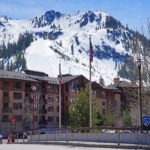
Elden Mountain

Elden Mountain is the rugged volcanic landmark that rises immediately northeast of Flagstaff, Arizona. Reaching approximately 9,305 feet (2,836 meters), the mountain towers more than 2,000 feet above the city and is one of the most recognizable features of the Flagstaff skyline.
Also widely known as Mount Elden, the mountain is an impressive dacite lava-dome complex within the San Francisco Volcanic Field. Its steep, rocky southern face looks very different from the smoother cinder cones scattered across northern Arizona because Elden was formed from thick, silica-rich lava that moved slowly and accumulated in massive overlapping lobes.
Elden Mountain is also one of Flagstaff’s classic hiking destinations. The strenuous Elden Lookout Trail climbs directly from the edge of town to a summit fire lookout, gaining roughly 2,400 feet in only a few miles. From the upper mountain, hikers can look across Flagstaff toward the higher San Francisco Peaks and Arizona’s highest summit, Humphreys Peak.
⚡ Fast Facts
| Feature | Details |
|---|---|
| Mountain | Elden Mountain |
| Alternate Name | Mount Elden |
| Country | United States |
| State | Arizona |
| County | Coconino County |
| Nearest City | Flagstaff |
| Elevation | 9,305 ft / 2,836 m |
| Prominence | 1,241 ft / 378 m |
| Isolation | 4.35 mi / 7.01 km |
| Nearest Higher Neighbor (NHN) | Schultz Peak |
| Key Col | Schultz Pass |
| Key Col Elevation | About 8,064 ft / 2,458 m |
| Coordinates | 35.2411° N, 111.5975° W |
| USGS Topographic Map | Flagstaff East |
| Volcanic Field | San Francisco Volcanic Field |
| Mountain Type | Exogenous dacite lava-dome complex |
| Approximate Age | About 500,000–600,000 years |
| Land Management | Coconino National Forest |
| Primary Hiking Route | Elden Lookout Trail |
| Trail Distance | About 5.2 miles round trip |
| Elevation Gain | About 2,400 ft |
| Notable Feature | Summit fire lookout |
📍 Where Is Elden Mountain?
Elden Mountain rises directly northeast of Flagstaff in northern Arizona’s Coconino National Forest.
Few Arizona mountains are so closely associated with a city. Elden’s steep southern slopes begin almost immediately beyond Flagstaff’s neighborhoods, and the mountain is visible from much of the community.
To the northwest, Schultz Pass separates Elden Mountain from the much larger San Francisco Peaks massif.
Beyond the pass rises Schultz Peak, Elden Mountain’s Nearest Higher Neighbor.
Farther northwest, the terrain continues upward toward Doyle Peak, Agassiz Peak, and Humphreys Peak.
Elden therefore occupies an interesting position between urban Flagstaff and the much wilder high country of the San Francisco Peaks.
⛰️ Nearest Higher Neighbor
Elden Mountain’s Nearest Higher Neighbor (NHN) is Schultz Peak.
Schultz Peak reaches approximately 10,083 feet and rises northwest of Elden on the southeastern flank of the San Francisco Peaks.
The two mountains are separated by Schultz Pass, which is also Elden’s topographic key col.
Elden’s key col is approximately 8,064 feet above sea level. Subtracting that elevation from Elden’s roughly 9,305-foot summit gives the mountain about 1,241 feet of topographic prominence.
That relatively substantial prominence helps explain why Elden looks so imposing from Flagstaff.
Interestingly, Schultz Peak is considerably higher but has much less prominence because it is connected to even higher terrain within the San Francisco Peaks.

🌋 Geology of Elden Mountain
Elden Mountain is one of the most distinctive volcanoes in the San Francisco Volcanic Field.
The volcanic field covers approximately 1,800 square miles of northern Arizona and contains more than 600 volcanic vents. Its history extends back about six million years.
Most of those volcanoes are relatively small basaltic cinder cones.
Elden is very different.
It consists primarily of dacite, a silica-rich volcanic rock produced by magma considerably more viscous than basalt.
Rather than flowing easily across the landscape, dacitic lava tends to move slowly and accumulate close to its vent.
That process produced Elden Mountain’s steep-sided form.
🪨 A Giant Lava Dome
The U.S. Geological Survey describes Elden Mountain as an excellent example of an exogenous lava dome.
Lava domes form when extremely viscous magma reaches the surface but cannot flow easily away from the vent.
Instead, the lava piles up.
An exogenous dome develops when magma breaks through the exterior of the growing dome and adds new lava to its surface.
Elden Mountain consists of several overlapping dacite lava lobes created through this process.
Some individual lobes extend considerable distances down the mountain’s flanks, giving Elden its complicated surface.
The result is a mountain far larger and more rugged than the small cinder cones that dominate much of the surrounding volcanic field.
⏳ How Old Is Elden Mountain?
Geologic dating indicates that Elden Mountain formed approximately 500,000 to 600,000 years ago during the Pleistocene Epoch.
Published potassium-argon dates from its dacitic rocks include ages around 490,000 and 570,000 years.
That makes Elden much older than Sunset Crater, whose most recent eruption occurred only about 900 years ago.
It formed during approximately the same broad period in which volcanic activity was constructing and reshaping other major features around Flagstaff.
The much larger San Francisco Mountain, whose surviving summits include Humphreys Peak, developed through volcanic activity occurring between roughly one million and 93,000 years ago.
💥 Elden Wasn’t Always a Quiet Lava Dome
Although slow-moving dacite created much of Elden Mountain, its volcanic history was not entirely gentle.
Geologists have identified pyroclastic deposits around the mountain, indicating that explosive volcanic activity also occurred.
This means Elden’s construction involved both relatively slow extrusion of viscous lava and more energetic explosive events capable of producing ash and fragmented volcanic material.
The mountain’s internal geology is even more complicated.
On portions of Elden, rising magma intruded beneath older sedimentary rocks and pushed them upward rather than simply erupting onto the surface.
These uplifted blocks help make Elden an especially useful location for studying interactions between volcanic intrusions and the much older sedimentary rocks of the Colorado Plateau.
🌋 Elden Mountain and the San Francisco Volcanic Field
Elden Mountain belongs to one of North America’s most remarkable volcanic landscapes.
The San Francisco Volcanic Field stretches roughly 50 miles from west to east across northern Arizona.
Its oldest volcanic centers occur toward Williams, while progressively younger eruptions generally migrated eastward toward Flagstaff and the Little Colorado River valley.
Major volcanic mountains in and around the field include Kendrick Peak, the San Francisco Peaks, and Elden Mountain.
Hundreds of smaller cinder cones cover the surrounding plateau.
The volcanic field remains geologically young. Its most recent eruption formed Sunset Crater roughly 900 years ago.
There is no indication that Elden Mountain itself is preparing to erupt again.
🌲 Forests of Elden Mountain
Despite its rocky appearance from Flagstaff, much of Elden Mountain is forested.
Ponderosa pine dominates large portions of the lower and middle elevations, forming part of the enormous ponderosa forest surrounding Flagstaff.
Gambel oak is also common.
Higher and cooler areas support additional conifers and scattered stands of aspen.
Wildfire has strongly influenced modern vegetation patterns, particularly on the mountain’s southern and southeastern slopes.
Some areas remain noticeably more open than they would have been before major twentieth-century fires, while aspen and other early-successional vegetation have colonized disturbed terrain.
These changes make the mountain particularly colorful during autumn.
🦌 Wildlife
Elden Mountain’s forests connect with the much larger Coconino National Forest landscape surrounding Flagstaff.
Wildlife can include elk, mule deer, coyotes, black bears, mountain lions, squirrels, and numerous forest birds.
Elk are especially characteristic of the Flagstaff high country and may occasionally be encountered near trails or roads.
The mountain’s proximity to neighborhoods does not mean it should be treated as an urban park.
Visitors quickly enter genuine national forest habitat, and normal precautions around wildlife remain important.
🔥 The 1977 Radio Fire
One of the most important events in Elden Mountain’s modern history was the Radio Fire of 1977.
The human-caused wildfire burned thousands of acres on the mountain and heavily damaged vegetation across its southern and southeastern slopes.
It also destroyed the existing summit fire lookout.
The effects remained visible for decades.
Large sections of mature ponderosa forest were replaced by more open vegetation and stands of regenerating aspen. The resulting patches of bright yellow autumn foliage eventually became one of the mountain’s distinctive seasonal features.
The fire also illustrates how closely Elden is connected to Flagstaff’s wildfire risk.
Because the mountain rises directly above developed areas, fires on Elden can pose an immediate threat to communities below.
🔭 Elden Fire Lookout
Elden Mountain has a long history as a wildfire observation point.
An early one-room lookout cabin was constructed near the summit in 1914.
A more substantial fire lookout tower replaced it in 1951.
That tower was destroyed during the Radio Fire in 1977.
A replacement lookout was subsequently constructed and remains on the upper mountain.
Its location provides an exceptional view across the forests surrounding Flagstaff, which explains why Elden has remained valuable for fire detection.
The summit also contains communications equipment, making the upper mountain somewhat more developed than many comparable Arizona peaks.
🥾 Hiking Elden Mountain
The classic hiking route is the Elden Lookout Trail.
It is short compared with many mountain hikes, but that statistic can be deceptive.
The route climbs approximately 2,400 vertical feet in about 2.6 miles, producing a sustained and strenuous ascent.
A typical round trip is approximately:
| Hiking Statistic | Approximate Value |
|---|---|
| Distance | 5.2 miles |
| Elevation Gain | 2,400 ft |
| Trailhead Elevation | About 6,900 ft |
| High Point | About 9,300 ft |
| Route Type | Out and back |
| Difficulty | Strenuous |
| Technical Class | Class 1 trail hiking |
The trail begins near U.S. Highway 89 on the northeastern edge of Flagstaff.
Almost immediately, hikers begin climbing.

🥾 Elden Lookout Trail
The Elden Lookout Trail ascends the mountain’s steep southern side through a succession of volcanic terrain and forest communities.
Lower sections pass through ponderosa pine and around large dacite boulders.
As the route gains elevation, views increasingly open over Flagstaff.
The trail uses numerous switchbacks to negotiate the steep slope, but there is relatively little flat terrain.
Higher sections cross areas affected by the 1977 Radio Fire, where younger vegetation contrasts with older forest.
Eventually, the trail reaches the summit ridge and Elden Lookout Road.
From there, hikers can continue toward the fire lookout and viewpoints across the surrounding volcanic landscape.
🪨 Fatman’s Loop
Hikers who want to experience Elden without climbing all the way to the summit can explore Fatman’s Loop Trail.
The loop begins from the same general trailhead area and winds through impressive volcanic boulders and ponderosa forest on Elden’s lower slopes.
It is much shorter and less demanding than the full summit hike.
The unusual rock formations along Fatman’s Loop also provide an excellent close-up look at Elden’s volcanic geology.
For visitors with limited time—or those who do not want a 2,400-foot climb—the loop offers a good introduction to the mountain.
🚵 Mount Elden–Dry Lake Hills Trail System
Elden is surrounded by one of Flagstaff’s most extensive recreation networks.
The Mount Elden–Dry Lake Hills Trail System contains numerous interconnected trails used for hiking, trail running, horseback riding, and mountain biking.
Trails connect the Elden area with Schultz Creek, Dry Lake Hills, Buffalo Park, and other portions of northern Flagstaff.
Some routes remain low on the mountain, while others climb considerably higher.
This network makes Elden much more than a single summit hike. It is one of the major outdoor-recreation landscapes immediately surrounding Flagstaff.
🚗 Elden Lookout Road
A forest road also reaches the upper mountain.
Elden Lookout Road provides access toward the summit and communications facilities, although road conditions and vehicle restrictions can change.
The road should not be assumed to be open or suitable for every vehicle.
Snow, mud, wildfire closures, maintenance, and seasonal restrictions can all affect access.
Anyone planning to drive rather than hike should check current Coconino National Forest conditions before traveling.
👀 Views From Elden Mountain
Elden Mountain offers some of the best elevated views of Flagstaff.
The city spreads immediately below the southern slopes, while the surrounding plateau stretches toward distant volcanic cones and mesas.
Looking northwest reveals a dramatically different landscape.
Schultz Peak rises beyond Schultz Pass, backed by the much higher San Francisco Peaks.
Humphreys Peak reaches 12,633 feet and dominates the skyline.
From Elden, hikers can clearly appreciate the enormous difference between the isolated lava dome beneath their feet and the remnants of the great stratovolcano to the northwest.
🧭 Schultz Pass
Schultz Pass lies between Elden Mountain and the San Francisco Peaks.
The pass is important both geographically and topographically.
It provides the low point along the ridge connecting Elden with higher terrain, making it Elden Mountain’s key col.
Its elevation of approximately 8,064 feet determines Elden’s roughly 1,241 feet of prominence.
The pass also provides an important travel corridor through the mountains north of Flagstaff and access to an extensive system of forest trails.
On the opposite side of the pass, the land climbs toward Schultz Peak and the higher San Francisco Peaks.
📜 Why Is It Called Elden Mountain?
The mountain takes its English-language name from John Elden, an early Euro-American settler who established a homestead near its base during the 1870s.
Forest Service planning documents state that Elden settled at the base of the mountain in 1877 and worked as a sheep herder.
The Elden name subsequently became attached to several local features, including Elden Mountain and Elden Springs.
The area has a much deeper human history, however.
The Coconino National Forest identifies Mount Elden as part of the San Francisco Peaks Traditional Cultural Property because of its significance to the Hopi.
Archaeological sites around the mountain also record centuries of Indigenous occupation long predating Flagstaff’s establishment.
🏺 Archaeology Around Elden Mountain
The landscape surrounding Elden Mountain contains an unusually high concentration of archaeological resources.
Coconino National Forest planning documents describe numerous pit-house settlements and small pueblos, many dating to periods following the eruption of Sunset Crater during the late eleventh century.
One of the best-known nearby archaeological locations is Elden Pueblo, situated near the mountain.
The site preserves evidence of people who lived in the Flagstaff region centuries before European-American settlement.
These cultural resources are protected.
Artifacts, pottery fragments, archaeological structures, and other historic materials should always be left exactly where they are found.
🌦️ Weather on Elden Mountain
Elden Mountain’s elevation produces much cooler conditions than those found across Arizona’s low deserts.
Summers can be pleasant, particularly during the morning, but afternoon thunderstorms are an important concern during the monsoon.
Lightning, heavy rain, hail, and sudden temperature changes can develop quickly.
Because much of the Elden Lookout Trail is exposed or partly exposed, an early start is advisable during thunderstorm season.
Autumn usually brings cooler temperatures and attractive fall color.
Winter frequently brings snow and ice to the mountain, turning the steep summit trail into a substantially more difficult outing.
🍂 Best Time to Hike Elden Mountain
Elden can be climbed during much of the year, but conditions vary dramatically by season.
Late spring and early summer often provide good hiking weather before the summer monsoon becomes established.
July and August can be beautiful but require careful attention to afternoon thunderstorms.
September and October are often excellent, particularly when aspen and Gambel oak begin changing color.
Winter hiking is possible but may require traction equipment, winter navigation skills, and preparation for snow or ice.
Because the trail climbs roughly 2,400 feet, temperatures at the summit can be significantly cooler than at the trailhead.
🎒 What to Bring
Despite its location beside Flagstaff, Elden Lookout Trail should be treated as a serious mountain hike.
Useful essentials include:
- Plenty of water
- Sun protection
- Sturdy hiking shoes
- Layers for changing temperatures
- Rain protection during monsoon season
- Map or offline navigation
- Snacks or lunch
- Traction equipment when snow or ice is present
The sustained elevation gain can also make the hike feel harder than its relatively short mileage suggests.
🌄 Why Elden Mountain Stands Out
Elden Mountain combines an unusual number of stories in one highly visible summit.
It is a half-million-year-old lava dome rising directly above a modern city.
It records the complicated volcanic history of northern Arizona, including both slow dacite extrusion and explosive eruptions.
Its forests preserve evidence of major wildfire and ecological recovery.
Its summit has been used for fire detection for more than a century.
And its slopes connect Flagstaff with one of Arizona’s richest networks of hiking and mountain-biking trails.
Most importantly, Elden is one of the best places to understand how unusual northern Arizona really is.
Standing on its summit, hikers can see a landscape containing hundreds of volcanoes—from small cinder cones to the towering San Francisco Peaks.
Elden Mountain is one of the most accessible places to experience that volcanic landscape firsthand.

❓ Frequently Asked Questions
How high is Elden Mountain?
Modern LiDAR measurements place Elden Mountain’s summit at approximately 9,305 feet (2,836 meters).
Older maps and references may list elevations around 9,299 to 9,301 feet.
Is it Elden Mountain or Mount Elden?
Both names are widely used. Peakbagger lists the summit as Elden Mountain, while local recreation references frequently use Mount Elden.
Where is Elden Mountain?
Elden Mountain rises immediately northeast of Flagstaff in Coconino County, Arizona.
What is Elden Mountain’s Nearest Higher Neighbor?
Its Nearest Higher Neighbor is Schultz Peak, northwest of Elden across Schultz Pass.
How prominent is Elden Mountain?
Elden has approximately 1,241 feet (378 meters) of topographic prominence.
What is Elden Mountain’s isolation?
Its topographic isolation is approximately 4.35 miles (7.01 kilometers).
Is Elden Mountain a volcano?
Yes. Elden is a volcanic lava-dome complex within the San Francisco Volcanic Field.
What kind of volcano is Elden Mountain?
It is primarily an exogenous dacite lava dome, formed when extremely viscous dacitic lava accumulated around a volcanic vent in overlapping lobes.
How old is Elden Mountain?
Geologic dating indicates that the Elden Mountain dome formed approximately 500,000 to 600,000 years ago.
Is Elden Mountain extinct?
There is no evidence suggesting an imminent eruption from Elden Mountain. Its lava-dome-building activity occurred hundreds of thousands of years ago.
The broader San Francisco Volcanic Field is geologically young, however, and experienced volcanic activity as recently as the eruption of Sunset Crater roughly 900 years ago.
How long is the Elden Mountain hike?
The standard Elden Lookout Trail hike is approximately 5.2 miles round trip.
How much elevation does the trail gain?
The route gains roughly 2,400 feet, making it a strenuous hike despite its relatively short distance.
Is there a fire lookout on Elden Mountain?
Yes. A fire lookout stands near the summit. Elden has been used for fire detection for more than a century.
Can you drive to the top of Elden Mountain?
A forest road reaches the upper mountain, but access and road conditions vary. Check current Coconino National Forest restrictions before attempting to drive to the summit area.
When is the best time to hike Elden Mountain?
Late spring through autumn usually provides the easiest conditions. September and early October can be particularly attractive because of fall foliage.
🔗 Related Articles
- Schultz Peak — Elden Mountain’s Nearest Higher Neighbor across Schultz Pass.
- San Francisco Peaks — the enormous volcanic massif northwest of Elden Mountain.
- Humphreys Peak — Arizona’s highest mountain and the dominant summit visible northwest of Elden.
- Kendrick Peak — another major volcanic mountain in the Flagstaff region.
📚 Sources
- Peakbagger — Elden Mountain
- U.S. Geological Survey — The San Francisco Volcanic Field, Arizona
- U.S. Geological Survey — San Francisco Volcanic Field
- Arizona Geological Survey — Mount Elden, Flagstaff, Arizona
- U.S. Geological Survey — Geologic Map of San Francisco Mountain, Elden Mountain, and Dry Lake Hills
- Coconino National Forest — Land and Resource Management Plan
- Grand Canyon Trust — Elden Lookout Trail