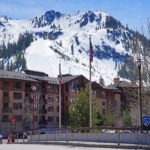
Freel Peak

Freel Peak is the highest mountain in the Carson Range and the highest summit in the Lake Tahoe Basin. Rising to approximately 10,883 feet (3,317 meters) on the California side of the range, the mountain stands south of Lake Tahoe along the boundary between El Dorado and Alpine counties. Its combination of substantial topographic prominence, expansive views, and access from the Tahoe Rim Trail makes it one of the most significant hiking summits in the Tahoe region.
🏔️ Overview
Freel Peak rises in the Carson Range, an eastern branch of the greater Sierra Nevada. The summit forms part of a high ridge south of Lake Tahoe that also includes Jobs Sister and Jobs Peak.
The mountain is especially notable for its prominence. Although many Sierra Nevada summits are considerably higher, Freel Peak rises more than 3,100 feet above its key saddle, giving it a commanding position above the surrounding landscape. To learn more about this measurement, see What Is Mountain Prominence?.
Freel Peak is also the high point of El Dorado County. Its nearest higher mountain is Highland Peak, more than 20 miles to the south-southeast.
⚡ Fast Facts
| Feature | Details |
|---|---|
| Continent | North America |
| Country | United States |
| State/Province | California |
| County/Region | Alpine and El Dorado counties |
| Mountain Range | Carson Range, Sierra Nevada |
| Parent Peak | Highland Peak |
| Elevation | Approximately 10,883 ft (3,317 m) |
| Prominence | Approximately 3,142 ft (958 m) |
| Isolation | Approximately 23.07 mi (37.13 km) |
| Nearest Higher Neighbor (NHN) | Highland Peak |
| Coordinates | Approximately 38.8575° N, 119.9002° W |
| Notable Distinction | Highest summit in the Carson Range and Lake Tahoe Basin; El Dorado County high point |
Elevation figures for Freel Peak vary slightly among mapping systems. Modern LiDAR-based measurements used by ListsOfJohn place the summit at about 10,883 feet, while older USGS mapping commonly gives 10,881 feet and some published sources list about 10,886 feet. These small differences reflect measurement methods and vertical datums rather than disagreement over the identity of the summit.
📍 Location
Freel Peak is located south of Lake Tahoe near the California-Nevada border. The summit itself remains entirely in California but sits directly on the boundary between Alpine County and El Dorado County.
The mountain occupies the southern portion of the Lake Tahoe Basin and overlooks both the forested Tahoe landscape to the north and the much drier Carson Valley region to the east. This location gives the summit a particularly dramatic contrast between the Sierra Nevada’s forested western landscapes and the arid Great Basin environment farther east.
Freel Peak is part of the Carson Range, generally considered a spur of the larger Sierra Nevada. Other major mountains farther south along the Sierra include Sonora Peak and Leavitt Peak.
📏 Elevation & Prominence
Modern LiDAR-based topographic data place the summit of Freel Peak at approximately 10,883 feet (3,317 meters).
Its prominence is approximately 3,142 feet (958 meters), making Freel Peak unusually prominent for a Sierra Nevada summit of its elevation. The mountain’s key saddle is around 7,741 feet.
Its topographic isolation is approximately 23.07 miles (37.13 kilometers). The higher terrain reached at that distance is associated with Highland Peak, which is therefore Freel Peak’s nearest higher neighbor and line parent.
This combination of more than 3,000 feet of prominence and roughly 23 miles of isolation explains why Freel Peak appears so dominant from many locations around the southern Lake Tahoe region.
For more information about how these figures differ, see Mountain Elevation vs. Prominence.
🪨 Geology
Freel Peak is part of the geologically complex Sierra Nevada region, but the mountain itself is strongly associated with the great granitic intrusive rocks of the Sierra Nevada batholith.
U.S. Geological Survey mapping identifies a Cretaceous granodiorite unit specifically called the Granodiorite of Freel Peak. Much of the broader Freel and Dardanelles area is underlain by Late Cretaceous granitic rocks belonging to the Sierra Nevada batholith.
These rocks formed when magma cooled and crystallized deep beneath the Earth’s surface during the Mesozoic Era. Subsequent uplift and erosion exposed the resistant granitic rocks that now form many of the mountain landscapes around Lake Tahoe.
Weathering has produced the exposed blocks, talus, sandy slopes, and decomposed granite frequently encountered near Freel Peak’s upper elevations.
🌿 Flora & Fauna
The climb toward Freel Peak passes through several elevation zones. Lower portions of the surrounding landscape support Sierra Nevada conifer forest, while conditions become progressively more exposed and severe near the summit.
Whitebark pine is particularly important in the high-elevation ecosystem around Freel Peak. Forest Service research has specifically studied whitebark pine populations in the Freel Peak area. These hardy trees survive cold temperatures, strong winds, heavy winter snow, and short growing seasons near the upper limits of tree growth.
Whitebark pine also has an important ecological relationship with Clark’s nutcracker. The birds collect the trees’ large seeds and cache them in the ground. Seeds that are not recovered may eventually germinate, making the birds an important means of whitebark pine seed dispersal.
At the highest elevations, trees become scattered or disappear altogether, leaving exposed rocky ground and low-growing alpine and subalpine vegetation adapted to cold, wind, snow, and intense sunlight.
🥾 Hiking & Climbing Routes
Freel Peak can be reached by several hiking approaches, with the Tahoe Rim Trail and Armstrong Pass area providing one of the most commonly used routes.
Armstrong Pass and Tahoe Rim Trail Route
A popular approach begins from the Forest Service Road 051 area near Luther Pass. Hikers follow trails toward Armstrong Pass before continuing on the Tahoe Rim Trail toward Freel Peak.
A summit trail eventually leaves the main Tahoe Rim Trail and climbs toward the top of the mountain.
Depending on the exact parking location and route variation, the trip is generally around 10 to 11 miles round trip with several thousand feet of total climbing. Forest Service Road 051 can be rough and deeply rutted, and access conditions may affect where hikers are able to park.
The upper portion of the hike becomes substantially steeper. Loose granite, sand, and exposed high-elevation terrain make the final climb more strenuous than the relatively gradual approach.
High Meadows Approach
Freel Peak can also be approached from the South Lake Tahoe side through the High Meadows trail system. This creates a substantially longer outing but allows hikers to travel through extensive forest and meadow terrain before joining the higher trail system below the peak.
Freel Peak, Jobs Sister, and Jobs Peak
Experienced hikers sometimes combine Freel Peak with neighboring Jobs Sister and Jobs Peak in a long ridge traverse commonly known among hikers as the Tahoe Triple Crown.
The combination involves significantly more elevation change and challenging high-country terrain than simply climbing Freel Peak.
Regardless of the chosen route, hikers should carry adequate water, navigation equipment, sun protection, extra clothing, and emergency supplies. See The Ten Essentials for Hiking before heading into the high country.
🏔️ Field Guide Tip: Freel Peak is high enough for weather and trail conditions to be dramatically different from those around Lake Tahoe. Snow can remain at upper elevations well into the hiking season, and the exposed summit offers little protection from wind or rapidly changing weather. Check current trail and road conditions before starting.

🌤️ Best Time to Visit
For most hikers, mid-summer through early fall provides the most favorable opportunity to climb Freel Peak.
Snow often covers the high country during winter and spring, sometimes lingering well after lower elevations around Lake Tahoe have become snow-free. Summer typically brings easier trail travel, but hikers must still account for the mountain’s elevation.
Afternoon thunderstorms can develop quickly in the Sierra Nevada during warmer months. Starting early reduces exposure to thunderstorms and provides additional time should the hike take longer than expected.
Early autumn can offer cooler temperatures and clear conditions, but daylight becomes shorter and the possibility of early-season snow increases.
Winter and spring ascents can involve deep snow, ice, avalanche terrain, difficult navigation, and considerably greater technical demands.
🧭 Nearby Mountains & Attractions
Jobs Sister rises immediately east of Freel Peak and is the second-highest summit in the Carson Range. The two mountains can be combined by hikers prepared for a longer high-elevation outing.
Jobs Peak lies farther east along the same mountain group and provides dramatic relief above Carson Valley.
Star Lake sits northwest of Freel Peak along the Tahoe Rim Trail. At roughly 9,100 feet, it is one of the highest lakes in the Lake Tahoe Basin and is surrounded by some of the area’s highest mountains.
Lake Tahoe dominates views to the north and northwest from the upper slopes, while the much lower Carson Valley spreads out to the east.
The broader northern Sierra Nevada also contains numerous prominent summits, including Highland Peak, Sonora Peak, and Leavitt Peak.
💡 Fun Facts
- Freel Peak is the highest summit in the Carson Range.
- It is also the highest point within the Lake Tahoe Basin.
- The summit forms the high point of El Dorado County, although the mountain is shared with Alpine County.
- Modern LiDAR measurements place the mountain slightly higher than the traditional 10,881-foot figure printed on older USGS maps.
- Freel Peak has more than 3,100 feet of topographic prominence, making it one of California’s more prominent mountain summits.
- The mountain’s line parent and nearest higher neighbor is Highland Peak, approximately 23 miles away.
- U.S. Geological Survey mapping identifies a rock unit called the Granodiorite of Freel Peak.
- Freel Peak has been used as a high-elevation ecological research site, including studies and monitoring of alpine environments and whitebark pine.
- The USGS assigned the name Freel Peak in 1893. The name honors James Freel, an early settler in the region.
❓ Frequently Asked Questions
How high is Freel Peak?
Modern LiDAR measurements place Freel Peak at approximately 10,883 feet (3,317 meters). Older sources commonly list elevations between 10,881 and 10,886 feet.
Is Freel Peak the highest mountain at Lake Tahoe?
Yes. Freel Peak is the highest summit in the Lake Tahoe Basin and the highest mountain in the Carson Range.
What county is Freel Peak in?
The summit lies on the boundary between El Dorado County and Alpine County, California. It is the highest point in El Dorado County.
How prominent is Freel Peak?
Freel Peak has approximately 3,142 feet (958 meters) of topographic prominence.
What is the nearest higher mountain to Freel Peak?
The nearest higher neighbor is Highland Peak, approximately 23 miles to the south-southeast.
Can you hike to the top of Freel Peak?
Yes. Hiking trails provide access to the summit, including approaches using the Tahoe Rim Trail near Armstrong Pass. The hike is strenuous because of its distance, elevation gain, high altitude, and steep upper slopes.
Does the Tahoe Rim Trail cross the summit?
No. The main Tahoe Rim Trail passes below Freel Peak. Hikers use a separate summit trail to leave the TRT and climb to the top.
What can you see from Freel Peak?
The exposed summit provides broad views across the Lake Tahoe Basin, Carson Range, Sierra Nevada, Carson Valley, and surrounding high country.
🔗 Related Articles
- Highland Peak
- Sonora Peak
- Leavitt Peak
- What Is Mountain Prominence?
- Mountain Elevation vs. Prominence
- What Is a Parent Peak?
🔗 Related Hiking and Safety Guides
📚 Sources
- Freel Peak – ListsOfJohn
- California County Prominence Peaks – Peakbagger
- Freel Peak – U.S. Geological Survey
- Geology of the Freel and Dardanelles Roadless Areas – U.S. Geological Survey
- Lake Tahoe Basin Management Unit Land Management Plan – U.S. Forest Service
- Maps & Trail Info – Tahoe Rim Trail Association
- Hiking Freel Peak via Forest Service Road 051 – Tahoe Trail Guide
- Freel Peak – Wikipedia