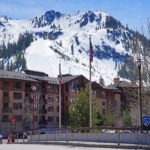
Haystack Mountain

🏔️ Overview
Haystack Mountain is a prominent summit in the southern Green Mountains of Vermont, rising immediately south of Mount Snow near the town of Wilmington. Its compact, steep-sided summit, high-elevation forests, rocky viewpoints, and nearby mountain pond make it one of the more distinctive hiking destinations in this part of Windham County.
The mountain is often listed at an elevation of 3,445 feet (1,050 meters) in older maps and references. Modern LiDAR-based measurements used by Peakbagger place the summit somewhat higher, at approximately 3,454.8 feet (1,053.0 meters). The difference reflects improved elevation measurement rather than any physical change to the mountain.
Haystack is closely connected geographically with Mount Snow. The two peaks lie along the same general north-south ridge, and Mount Snow is Haystack Mountain’s nearest higher neighbor.
Much of Haystack Mountain lies within the Green Mountain National Forest, although developed private property occupies portions of its lower slopes. A public hiking route approaches the summit from the Chimney Hill area southeast of the mountain.
Despite its relatively modest elevation by Vermont standards, Haystack rewards hikers with broad views across the Deerfield Valley and toward mountains in Vermont, Massachusetts, and New Hampshire.
⚡ Fast Facts
| Fact | Details |
|---|---|
| Continent | North America |
| Country | United States |
| State/Province | Vermont |
| County/Region | Windham County |
| Town | Wilmington |
| Mountain Range | Green Mountains / Appalachian Mountains |
| Parent Peak | Mount Snow |
| Elevation | 3,454.8 ft (1,053.0 m), modern LiDAR measurement |
| Traditional Elevation | 3,445 ft (1,050 m) |
| Prominence | 380.2 ft (115.8 m) |
| Isolation | 2.1 mi (3.38 km) |
| Nearest Higher Neighbor (NHN) | Mount Snow |
| Key Col | Approximately 3,075 ft (937 m) |
| Coordinates | 42.91386° N, 72.91915° W |
| Protected Area | Green Mountain National Forest |
| Primary Activity | Hiking |
📍 Location
Haystack Mountain stands in Wilmington, Vermont, in southern Windham County. The summit forms part of the Southern Green Mountains and lies roughly south of Mount Snow, one of the best-known mountains and ski destinations in southern Vermont.
Peakbagger places the summit at approximately 42.91386° N, 72.91915° W and identifies it as the high point of the town of Wilmington.
The mountain occupies a scenic position above the Deerfield Valley, a broad mountain region centered around Wilmington and Dover. From the summit area, hikers can look east across the valley toward the hills of southern New Hampshire.
Haystack Mountain is part of the broader Appalachian mountain system. Nearby peaks include Mount Snow immediately to the north, Stratton Mountain farther north, and Glastenbury Mountain to the west.
📏 Elevation & Prominence
Haystack Mountain provides a good example of how modern mapping technology can change the accepted elevation of a summit.
The mountain has traditionally been listed at 3,445 feet (1,050 meters). This remains the elevation commonly encountered in older hiking guides and references.
Peakbagger’s current LiDAR-based measurement gives the summit an elevation of 3,454.8 feet (1,053.0 meters).
Its topographic prominence is approximately 380.2 feet (115.8 meters). The mountain’s key col is around 3,075 feet (937 meters).
Haystack has a topographic isolation of approximately 2.1 miles (3.38 kilometers). Peakbagger identifies Mount Snow, directly to the north, as its nearest higher neighbor.
Mount Snow rises to approximately 3,599 feet according to modern LiDAR measurements, making it only moderately higher than Haystack but substantially more prominent.
🪨 Geology
Haystack Mountain belongs to the Southern Green Mountains, which are part of the much larger Appalachian mountain system.
The Green Mountains are built largely from ancient metamorphic rocks that were altered by enormous pressures and temperatures during several episodes of Appalachian mountain building. Folding, faulting, metamorphism, erosion, and uplift all contributed to the landscape seen in Vermont today.
The mountains themselves are vastly older than their present-day appearance. Hundreds of millions of years of erosion have worn away the once much higher mountain ranges produced during Paleozoic continental collisions.
Much more recently, continental glaciers repeatedly covered Vermont during the Pleistocene. Ice reshaped valleys, scoured exposed bedrock, transported boulders and sediment, and helped produce the rounded but rugged form characteristic of the Green Mountains.
Haystack’s steep summit cone and exposed rock near the summit are therefore the products of both extremely ancient geological processes and much younger glacial erosion.
🌿 Flora & Fauna
Haystack Mountain’s substantial elevation creates noticeable changes in its forests.
Lower and middle elevations are characteristic of Vermont’s northern hardwood forest, where trees such as sugar maple, American beech, and yellow birch are widespread.
Higher on the mountain, hikers enter a cooler forest environment increasingly influenced by red spruce and balsam fir.
Trail Finder specifically notes the accessibility of the mountain’s montane spruce-fir forest, an ecological community normally associated with the higher parts of Vermont’s mountains. Because the trail begins at roughly 2,400 feet above sea level, hikers reach this high-elevation environment without having to climb from the valley floor.
The surrounding Green Mountain National Forest supports typical Vermont woodland wildlife, including white-tailed deer, black bears, moose, red squirrels, snowshoe hares, bobcats, and numerous forest birds.
Wildlife sightings are never guaranteed, and black bears generally avoid people. Food and scented items should nevertheless be handled responsibly anywhere in Vermont’s bear country.
🥾 Hiking & Climbing Routes
The principal public route is the Haystack Mountain Trail, managed by the U.S. Forest Service with some maintenance assistance from the Wilmington Trails Committee.
Trail Finder lists the route at approximately 2.1 miles one way, making a summit hike roughly 4.2 miles round trip when returning by the same route.
The hike gains about 1,000 vertical feet.
The route initially follows a gated gravel road before transitioning onto a footpath. It climbs gradually at first before becoming considerably steeper as it approaches the summit ridge.
A final narrower trail twists upward toward the rocky summit.
The current U.S. Forest Service description identifies the route as blue-blazed. However, Trail Finder has cautioned that signs and trail markers can be limited in places, so hikers should carry a map, downloaded trail data, or another reliable navigation method.
The trailhead is reached from Upper Dam Road in the Chimney Hill development near Wilmington.
Summit Views
The summit itself is small and rocky rather than a broad open plateau.
The primary viewpoint faces east over Wilmington and Dover in the Deerfield Valley. On especially clear days, Mount Monadnock in New Hampshire can be visible on the horizon.
Haystack Pond can be seen below the summit, while Mount Snow rises prominently to the north.
Another informal viewpoint provides views south toward Harriman Reservoir, the mountains around Searsburg, and distant Mount Greylock, the highest mountain in Massachusetts.
🏔️ Field Guide Tip: Haystack Mountain is relatively short compared with many major Green Mountain hikes, but the final climb is steep and the route can be wet, muddy, icy, or snow-covered depending on the season. Do not judge the hike solely by its mileage.
💧 Haystack Pond
One of Haystack Mountain’s most distinctive natural features is Haystack Pond, which occupies a high basin immediately below the summit.
The pond is surrounded by wetlands and forest and is accessible only by trail.
Nearby Crystal Pond is connected with the same high-elevation watershed. Water leaving this portion of the mountain eventually contributes to streams flowing toward the Deerfield River system.
The presence of a substantial pond so close to the summit adds an unusual element to Haystack’s landscape and makes the view from the summit particularly recognizable.
Haystack Pond also has a history of scientific interest because researchers have studied changes in its acidity associated with historical acid deposition in northeastern North America.
🌤️ Best Time to Visit
For most hikers, the best period for climbing Haystack Mountain is late spring through fall.
Summer
Summer generally provides the easiest hiking conditions, although the trail can become muddy after periods of rain.
The forest canopy is fully developed, and the higher spruce-fir forest provides a noticeably cooler environment than the surrounding valleys.
Fall
Autumn is especially scenic because Haystack overlooks the heavily forested Deerfield Valley.
Northern hardwood forests on the surrounding hills produce the red, orange, and yellow foliage for which southern Vermont is famous.
Winter
Haystack can also be climbed in winter, but snow and ice can dramatically change the difficulty of the trail.
Microspikes or snowshoes may be appropriate depending on conditions, and hikers should be prepared for much colder temperatures near the summit.
Spring
Early spring can bring lingering snow and ice at higher elevations while lower sections become muddy from snowmelt.
Hikers should avoid unnecessarily widening trails when encountering saturated ground.
🧭 Nearby Mountains & Attractions
Haystack Mountain is surrounded by several noteworthy mountains and recreation areas in southern Vermont.
Mount Snow lies directly north of Haystack and is the mountain’s nearest higher neighbor. The two summits form part of the same prominent ridge above the Deerfield Valley.
Stratton Mountain rises farther north and is one of the major summits of the Southern Green Mountains.
Glastenbury Mountain lies west of the Deerfield Valley and is another important high summit within Green Mountain National Forest.
Harriman Reservoir, also known as Lake Whitingham, lies south and west of Wilmington and can be seen from a viewpoint near Haystack’s summit.
Wilmington itself provides the primary community base for visitors exploring the mountain and the surrounding Deerfield Valley.
The broader Green Mountains provide hundreds of miles of hiking opportunities throughout Vermont.
💡 Fun Facts
- Haystack Mountain is the highest point in the town of Wilmington.
- The summit’s modern LiDAR elevation is approximately 10 feet higher than its traditionally published 3,445-foot elevation.
- Mount Snow is both Haystack’s nearest higher neighbor and its topographic parent.
- Haystack Mountain and Mount Snow lie along the same major north-south ridge.
- High-elevation spruce-fir forest can be reached relatively quickly because the main trail begins at approximately 2,400 feet.
- Haystack Pond lies directly beneath the summit and is one of the mountain’s most recognizable landscape features.
- On clear days, hikers may see Mount Monadnock in New Hampshire from the summit.
- Another viewpoint can reveal Mount Greylock in Massachusetts, giving Haystack views toward the highest summit in Massachusetts.
- Parts of the mountain’s northeastern slopes have a long history of alpine skiing development.
❓ Frequently Asked Questions
How high is Haystack Mountain in Vermont?
Haystack Mountain has traditionally been listed at 3,445 feet (1,050 meters).
Modern LiDAR data used by Peakbagger places the summit at approximately 3,454.8 feet (1,053.0 meters).
Where is Haystack Mountain?
Haystack Mountain is located in Wilmington, Windham County, Vermont, in the southern Green Mountains.
Is Haystack Mountain in Green Mountain National Forest?
Much of Haystack Mountain, including land around the summit, is part of Green Mountain National Forest.
How long is the hike up Haystack Mountain?
Trail Finder lists the main Haystack Mountain Trail at approximately 2.1 miles one way, resulting in a hike of roughly 4.2 miles round trip when returning by the same route.
The hike gains approximately 1,000 feet.
Is Haystack Mountain difficult to hike?
It is a relatively short mountain hike, but portions of the trail are steep.
Trail Finder currently classifies the route as advanced, despite describing the overall outing as a moderate hike. Conditions can make a significant difference: mud, snow, and ice considerably increase the difficulty.
Are dogs allowed on Haystack Mountain Trail?
Trail Finder lists dogs as permitted on leash.
Hikers should always check current Forest Service regulations and trail notices before visiting.
What can you see from Haystack Mountain?
Views include the Deerfield Valley, Wilmington, Dover, Haystack Pond, Mount Snow, and portions of southern Vermont.
In clear conditions, Mount Monadnock in New Hampshire and Mount Greylock in Massachusetts may also be visible.
What is Haystack Mountain’s nearest higher neighbor?
According to Peakbagger, the Nearest Higher Neighbor (NHN) is Mount Snow, approximately 2.1 miles to the north.
Is Haystack Mountain the same as the Haystack ski area?
The mountain has supported alpine skiing development on its northeastern side, historically known as the Haystack Mountain Ski Area. The public hiking route to the summit is a separate trail associated with Green Mountain National Forest and the Chimney Hill side of the mountain.
Is Haystack Mountain worth hiking?
For hikers looking for a relatively compact Southern Vermont summit hike, Haystack offers an excellent combination of high-elevation forest, a steep summit climb, rocky viewpoints, and views of the surrounding Green Mountains.
Its proximity to Wilmington and Mount Snow also makes it easy to combine with other destinations in the Deerfield Valley.
🔗 Related Articles
- Mount Snow
- Glastenbury Mountain
- Stratton Mountain
- Green Mountains
- Mountain Ranges in the U.S.
- What Is Mountain Prominence?
- Mountain Elevation vs. Prominence
- What Is a Parent Peak?
🔗 Related Hiking and Safety Guides
📚 Sources
- Peakbagger — Haystack Mountain, Vermont
- U.S. Forest Service — Haystack Mountain Trail
- Trail Finder — Haystack Mountain (Wilmington)
- Town of Wilmington — Trails
- U.S. Forest Service — Green Mountain and Finger Lakes National Forests
- Wikipedia — Haystack Mountain (Vermont)