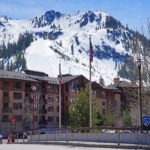
Ontario Peak

🏔️ Overview
Ontario Peak is an 8,703-foot summit in the eastern San Gabriel Mountains of Southern California. Rising dramatically above the Inland Empire, the mountain combines extensive views, rugged wilderness scenery, mixed-conifer forests, and one of the region’s classic strenuous day hikes.
The summit stands within the Cucamonga Wilderness in San Bernardino County. This protected landscape is divided between the Angeles and San Bernardino national forests, although the standard hiking approach to Ontario Peak follows trails administered primarily by the Angeles National Forest.
Ontario Peak is often listed at 8,696 feet, an elevation carried on older maps and still repeated in many hiking guides. More recent lidar-based measurements place the summit at approximately 8,702.7 feet, normally rounded to 8,703 feet.
Despite being lower than nearby Cucamonga Peak, Ontario Peak has more than 1,000 feet of topographic prominence. Its broad summit ridge provides expansive views across the San Gabriel Mountains, the Inland Empire, and—when visibility is unusually clear—the distant Los Angeles Basin and Pacific horizon.
⚡ Fast Facts
| Fact | Details |
|---|---|
| Continent | North America |
| Country | United States |
| State/Province | California |
| County/Region | San Bernardino County |
| Mountain Range | San Gabriel Mountains |
| Protected Area | Cucamonga Wilderness |
| Parent Peak | Cucamonga Peak |
| Elevation | 8,703 feet / 2,653 meters |
| Traditional Mapped Elevation | 8,696 feet / 2,651 meters |
| Prominence | 1,046 feet / 319 meters |
| Isolation | 2.07 miles / 3.33 kilometers |
| Nearest Higher Neighbor (NHN) | Cucamonga Peak |
| Coordinates | 34.22771° N, 117.62402° W |
| USGS Quadrangle | Cucamonga Peak |
| Standard Trailhead | Icehouse Canyon Trailhead |
| Typical Round-Trip Distance | Approximately 12.5–13 miles |
| Typical Elevation Gain | Approximately 4,000–4,200 feet |
📍 Location
Ontario Peak is located in the eastern San Gabriel Mountains, north of the cities of Ontario, Upland, and Rancho Cucamonga. The summit lies approximately 12 miles north of the city of Ontario, from which the mountain received its name.
The mountain occupies the western portion of the Cucamonga Wilderness, a rugged protected area characterized by steep canyons, high ridges, intermittent streams, and elevations approaching 9,000 feet. Congress originally designated the Cucamonga Wilderness in 1964.
The wilderness is jointly administered by the Angeles and San Bernardino national forests. Ontario Peak, the Ontario Peak Trail, and much of the standard Icehouse Canyon approach are associated with the Angeles National Forest side of the wilderness, while nearby destinations such as Cucamonga Peak extend into areas managed by the San Bernardino National Forest.
The most common access point is the Icehouse Canyon Trailhead on Mount Baldy Road, a short distance north of Mount Baldy Village.
📏 Elevation & Prominence
Ontario Peak reaches a lidar-measured elevation of approximately 8,702.7 feet, or 2,652.6 meters. This figure is more precise than the traditional 8,696-foot elevation found on older maps and numerous hiking websites.
Its topographic prominence is approximately 1,045.6 feet, or 318.7 meters. This means a climber would need to descend more than 1,000 vertical feet from Ontario Peak before reaching terrain that eventually rises to a higher summit.
The mountain has a topographic isolation of approximately 2.07 miles. Its nearest higher terrain lies toward Cucamonga Peak, which reaches approximately 8,862 feet and serves as both Ontario Peak’s parent peak and nearest higher neighbor.
Ontario Peak is therefore a relatively independent summit rather than a minor bump on a larger ridge. Its combination of elevation, prominence, and steep relief makes it one of the more visually significant mountains along the southern front of the San Gabriel range.
Learn more about these measurements in What Is Mountain Prominence? and What Is a Parent Peak?.
🪨 Geology
Ontario Peak is part of the Transverse Ranges, a geologically unusual mountain system that runs primarily east to west across Southern California.
The bedrock around Ontario Peak includes quartz diorite and related crystalline rocks. Geological studies of the Cucamonga Wilderness have dated quartz diorite in the Ontario Peak area to approximately 80–115 million years old, placing its formation during the Cretaceous Period.
Quartz diorite is an intrusive igneous rock formed when magma cooled slowly beneath Earth’s surface. Later uplift and erosion exposed these once-deep rocks, which now appear along the mountain’s ridges, outcrops, and steep canyon walls.
The eastern San Gabriel Mountains are a fault-bounded block undergoing continued tectonic uplift. The range is bordered to the south by the Cucamonga fault zone, a major system of north-dipping thrust faults created by compression within Southern California’s complex plate boundary.
Continued uplift, combined with erosion, landslides, rockfall, and the cutting action of streams, has produced Ontario Peak’s sharp relief. The mountain rises steeply from the urban valleys to the south, while deep drainages separate it from surrounding ridges.
Unlike the Sierra Nevada, Ontario Peak was not extensively sculpted by large alpine glaciers. Its present landscape primarily reflects tectonic uplift, weathering, stream erosion, mass movement, and seasonal freeze-thaw activity.
🌿 Flora & Fauna
Ontario Peak’s vegetation changes considerably between Icehouse Canyon and the summit ridge.
The lower approach follows Icehouse Creek through a comparatively moist canyon environment. Trees and shrubs benefit from greater shade and seasonal water, creating a cooler setting than the exposed slopes above.
At higher elevations, the landscape transitions into mixed-conifer forest. Tree species documented in the Cucamonga Wilderness include:
- Ponderosa pine
- Jeffrey pine
- Bigcone Douglas-fir
- Other drought- and cold-tolerant mountain conifers
Open ridges and rocky summit areas support more widely spaced trees, low shrubs, grasses, and plants adapted to thin soils, strong winds, summer drought, and winter snow.
The Cucamonga Wilderness also provides habitat for several large mammals, including:
- Mule deer
- American black bears
- Mountain lions
- Nelson bighorn sheep
Most large animals avoid busy trails and are more likely to be active around dawn, dusk, or quieter parts of the wilderness. Hikers should observe wildlife from a distance, secure food properly, and avoid approaching or feeding animals.
Rattlesnakes may occur along warmer, lower portions of the route, especially during spring and summer. Higher on the mountain, hikers are more likely to notice squirrels, chipmunks, lizards, woodpeckers, jays, and other forest birds.
🥾 Hiking & Climbing Routes
Icehouse Canyon to Ontario Peak
The standard route begins at the Icehouse Canyon Trailhead on Mount Baldy Road. It is generally considered a strenuous day hike because of its distance, elevation gain, altitude, and sustained climbing.
Typical estimates for the complete hike are:
- Distance: Approximately 12.5–13 miles round trip
- Elevation gain: Approximately 4,000–4,200 feet
- Difficulty: Strenuous
- Time required: Commonly 7–10 hours, depending on conditions and pace
The Icehouse Canyon Trail climbs beside Icehouse Creek, passing old recreation cabins, shaded forest, rocky slopes, and several trail junctions. The trail reaches Icehouse Saddle after approximately 3.7 miles.
From the saddle, hikers follow the Ontario Peak Trail toward Kelly Camp. The route then continues along the ridge system near Bighorn Peak before making its final approach to Ontario Peak.
The summit area is relatively broad and wooded compared with the exposed summits of some neighboring mountains. Several viewpoints near the high point provide better unobstructed views than the exact summit marker.
Bighorn Peak Variation
Bighorn Peak stands southeast of Ontario Peak and may be added as a secondary summit. The route to Bighorn leaves the main Ontario Peak Trail and follows a considerably steeper path.
Although Bighorn Peak is lower at approximately 8,445 feet, the side trip involves loose ground and a demanding return climb. It is best attempted by hikers who still have sufficient time, water, and energy after completing most of the ascent.
Ontario and Cucamonga Peaks
Strong hikers sometimes combine Ontario Peak with Cucamonga Peak during a long multi-summit outing. The most straightforward version generally involves returning toward Icehouse Saddle and then following the separate trail toward Cucamonga Peak.
This extension substantially increases the day’s mileage and total climbing. It should not be treated as an ordinary addition to the Ontario Peak hike.
Winter Ascents
Ontario Peak receives snow and ice during winter and following major spring storms. Shaded parts of Icehouse Canyon and the upper trail can retain frozen snow long after lower elevations have melted.
Under winter conditions, the route can require mountaineering judgment, traction equipment, an ice axe, navigation skills, and experience with self-arrest. Microspikes alone are not adequate for every combination of slope angle and snow condition.
Several trails in the Mount Baldy and Icehouse Canyon region have also been temporarily closed during severe winter weather. Always check current Forest Service alerts before leaving home.
🏔️ Field Guide Tip: Begin early, carry more water than you expect to need, and save energy for the return climb around the Ontario–Bighorn ridge. The hike’s distance and elevation gain make the descent more tiring than it initially appears.
Permits and Parking
Forest Service regulations differ between the Angeles and San Bernardino portions of the Cucamonga Wilderness.
Current Forest Service guidance states that a permit is not required for Ontario Peak when approached by the Ontario Peak Trail. Permits are encouraged but voluntary within the Angeles National Forest portion of the wilderness.
A permit is required when entering certain areas administered by the San Bernardino National Forest, including routes continuing beyond Icehouse Saddle toward Cucamonga Peak and other interior destinations.
Because boundaries, closures, fire restrictions, and permit procedures can change, hikers should verify current requirements with the Forest Service before their trip.
A National Forest Adventure Pass or another accepted federal recreation pass may be required for parking at developed trailheads in the Mount Baldy area.
🌤️ Best Time to Visit
The most dependable hiking periods are generally late spring through fall, but conditions vary considerably from year to year.
Late Spring
Late spring can bring flowing water, green vegetation, and comfortable temperatures. However, snow and ice may remain on shaded upper slopes following a wet winter.
Summer
Summer offers long daylight hours and usually snow-free trails. Temperatures can become hot at lower elevations, while exposed sections receive strong sunlight.
Water sources are seasonal and should never be assumed reliable. Carry all the water needed for the complete hike.
Fall
Fall often provides the most favorable combination of cooler temperatures, dry trails, and clear skies. Shorter daylight hours make an early start increasingly important later in the season.
Winter
Winter transforms Ontario Peak into a more serious mountaineering objective. Snow, hard ice, rapidly changing weather, and limited visibility can make the familiar summer trail hazardous.
Winter attempts should be reserved for hikers with appropriate training, equipment, and an accurate understanding of current conditions.
🧭 Nearby Mountains & Attractions
Bighorn Peak
Bighorn Peak lies along the ridge southeast of Ontario Peak. Although lower than Ontario, it has steep slopes and provides impressive views toward Cucamonga Peak and the Inland Empire.
Cucamonga Peak
Cucamonga Peak rises east of Ontario Peak and is its nearest higher neighbor. Its rocky summit is one of the most recognizable landmarks above Rancho Cucamonga and Upland.
Timber Mountain
Timber Mountain is reached from the Icehouse Saddle area by following the Three T’s Trail. It offers another strenuous but popular summit destination in the same trail network.
Mount San Antonio
Mount San Antonio, commonly known as Mount Baldy, is the highest mountain in the San Gabriel Mountains. Its 10,000-foot summit rises northwest of Ontario Peak.
Pine Mountain
Pine Mountain stands near Mount San Antonio and reaches approximately 9,652 feet. It is considerably more difficult to reach than Ontario Peak.
Icehouse Canyon
Icehouse Canyon is more than an approach route. The lower canyon is a popular destination in its own right, with a seasonal creek, historic cabins, shaded forest, and connections to multiple mountain trails.
💡 Fun Facts
- Ontario Peak takes its name from the city of Ontario, located approximately 12 miles to the south.
- The name appeared in a United States General Land Office forest atlas as early as 1908.
- The often-repeated 8,696-foot elevation is based on older mapping; lidar places the summit closer to 8,703 feet.
- Ontario Peak has more than 1,000 feet of prominence, making it one of the more topographically independent summits in the San Gabriel Mountains.
- The mountain is part of the Sierra Club Hundred Peaks Section list.
- On exceptionally clear days, hikers may see across the Inland Empire toward distant mountain ranges and the coastal basin.
- Ontario Peak, Bighorn Peak, and Cucamonga Peak form a striking high ridge that rises abruptly above Southern California’s urban communities.
- The summit is slightly lower than Cucamonga Peak but higher than nearby Bighorn and Timber mountains.
❓ Frequently Asked Questions
How high is Ontario Peak?
Ontario Peak has a modern lidar-measured elevation of approximately 8,703 feet, or 2,653 meters. Older maps commonly list an elevation of 8,696 feet.
Where is Ontario Peak?
The mountain is in San Bernardino County, California, within the Cucamonga Wilderness of the eastern San Gabriel Mountains.
Is Ontario Peak a difficult hike?
Yes. The standard route is approximately 12.5–13 miles round trip with around 4,000–4,200 feet of elevation gain. It is generally rated as strenuous.
What is the easiest route to Ontario Peak?
The standard route follows the Icehouse Canyon Trail to Icehouse Saddle and then takes the Ontario Peak Trail past the Kelly Camp area toward the summit.
Is a permit required?
Current Forest Service guidance states that a permit is not required for Ontario Peak via the Ontario Peak Trail. Requirements change when hikers enter the San Bernardino National Forest portion of the Cucamonga Wilderness or continue toward other summits, so regulations should be checked before each trip.
Is a parking pass required?
A National Forest Adventure Pass or another accepted federal recreation pass may be required at the Icehouse Canyon Trailhead. Check posted signs and current Forest Service information.
Are dogs allowed on Ontario Peak?
Dogs are generally permitted in the national forest wilderness, but they must remain under control. Forest Service rules may require a leash no longer than six feet in certain areas.
Owners should consider heat, sharp rocks, snow, wildlife, and the route’s considerable distance before bringing a dog.
Is there water along the trail?
Icehouse Creek and other small water sources are seasonal. Water availability should never be assumed, and any natural water must be properly treated.
Can beginners hike Ontario Peak?
Ontario Peak is not an ideal first mountain hike. Fit beginners may complete it under dry summer or fall conditions, but they should already be comfortable with long distances, major elevation gain, navigation, and changing mountain weather.
Does Ontario Peak receive snow?
Yes. Snow commonly falls during winter storms and can remain on shaded sections into spring or early summer. Frozen snow and ice can make the route significantly more dangerous.
What can be seen from Ontario Peak?
Views may include Cucamonga Peak, Bighorn Peak, Mount San Antonio, the Inland Empire, portions of the Los Angeles and Orange County basins, and distant Southern California mountain ranges. Coastal and ocean views depend heavily on atmospheric clarity.
🔗 Related Articles
- San Gabriel Mountains
- Cucamonga Peak
- Mount San Antonio
- Pine Mountain, California
- Timber Mountain
- Strawberry Peak
- What Is Mountain Prominence?
- What Is a Parent Peak?
📚 Sources
- Peakbagger – Ontario Peak
- U.S. Geological Survey – Geographic Names Information System
- Angeles National Forest – Wilderness Areas
- San Bernardino National Forest – Cucamonga Wilderness
- Angeles National Forest – Icehouse Canyon Saddle via Icehouse Canyon
- U.S. Geological Survey – Geologic Map of the Cucamonga Peak Quadrangle
- U.S. Geological Survey – Mineral Resources of the Cucamonga Wilderness
- San Bernardino National Forest – Geology