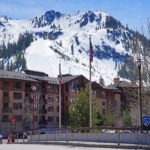
Red Lake Peak rises immediately north of Carson Pass in California’s central Sierra Nevada, forming a rugged volcanic summit above Highway 88 and the upper Carson River country. At approximately 10,069 feet (3,069 meters), it is not among the tallest Sierra peaks, but its substantial prominence, volcanic geology, historical importance, and commanding views make it one of the most interesting mountains south of Lake Tahoe.
The peak is especially associated with explorer John C. Frémont and cartographer Charles Preuss, who climbed in this area during their difficult winter crossing of the Sierra Nevada in February 1844. Red Lake Peak is traditionally identified as the vantage point from which members of the expedition made the first recorded sighting of Lake Tahoe by Euro-Americans.
🏔️ Overview
Red Lake Peak stands in Alpine County, California, only a short distance north of Carson Pass. It forms part of the Sierra Nevada and occupies a particularly interesting section of the range where comparatively young volcanic rocks overlie and obscure portions of the much older Sierra Nevada landscape.
Unlike the immense granite summits that characterize much of the High Sierra, Red Lake Peak preserves evidence of volcanic activity associated with the ancestral Cascades volcanic arc. Basaltic and andesitic rocks around the mountain date to roughly six to seven million years ago.
The mountain also has considerable topographic independence. Current Peakbagger data give Red Lake Peak approximately 1,493 feet (455 meters) of prominence, while its nearest higher neighbor is Round Top, about 3.6 miles to the south-southwest.
⚡ Fast Facts
| Fact | Details |
|---|---|
| Continent | North America |
| Country | United States |
| State/Province | California |
| County/Region | Alpine County |
| Mountain Range | Sierra Nevada |
| Parent Peak | Round Top |
| Elevation | Approximately 10,069 feet / 3,069 meters |
| Prominence | Approximately 1,493 feet / 455 meters |
| Isolation | Approximately 3.56 miles / 5.73 kilometers |
| Nearest Higher Neighbor (NHN) | Round Top |
| Coordinates | 38.71476° N, 119.98692° W |
| USGS Topographic Map | Carson Pass |
| Summit Difficulty | Up to YDS Class 3 on the summit block |
| Historic Ascent | February 1844, John C. Frémont and Charles Preuss |
| Nearby Highway | California State Route 88 |
| Nearby Pass | Carson Pass |
🏔️ Field Guide Tip: Red Lake Peak should not be treated as an ordinary trail hike. Although the approach from Carson Pass is comparatively short, the route eventually leaves maintained trail, and reaching the highest point can involve exposed Class 3 scrambling. Hikers uncomfortable with exposed rock should be prepared to turn around below the true summit.
📍 Location
Red Lake Peak is positioned just north of Carson Pass, one of the historic crossings of the central Sierra Nevada. California State Route 88 crosses the range immediately south of the mountain, providing unusually convenient access to high-elevation terrain.
The summit rises northwest of Red Lake, the small body of water from which the mountain takes its name.
The surrounding landscape includes several prominent mountains and landmarks:
- Round Top to the south-southwest
- Elephants Back south of Carson Pass
- Stevens Peak to the northeast
- Red Lake below the southeastern slopes
- Lake Tahoe farther north
- The Carson Pass high country immediately south
The location places Red Lake Peak near the transition between the Lake Tahoe region and the central Sierra Nevada.
📏 Elevation & Prominence
Modern LiDAR-based figures have refined some of the older measurements published for Red Lake Peak.
Peakbagger currently lists the summit at 10,068.7 feet, normally rounded to 10,069 feet (3,069 meters). Its topographic prominence is approximately 1,493 feet (455 meters).
Older references frequently give an elevation of 10,063 or 10,068 feet and a prominence of about 1,463 feet. These differences largely reflect the use of older topographic maps versus newer elevation datasets.
Peakbagger calculates an isolation of approximately 3.56 miles (5.73 kilometers).
The nearest higher neighbor is Round Top, situated south-southwest of Red Lake Peak. ListsOfJohn likewise identifies Round Top as both its line parent and proximate parent.
This makes Round Top the correct NHN for the Fast Facts table.
🪨 Geology
Red Lake Peak is particularly interesting because its geology differs from the granite-dominated scenery commonly associated with the Sierra Nevada.
The Carson Pass region preserves remnants of volcanic activity associated with the ancestral Cascades arc. During the Miocene and Pliocene epochs, lava, volcanic debris, and pyroclastic material accumulated across an older landscape of valleys and channels.
Geological research in the Carson Pass–Kirkwood region identifies a volcanic sequence on Red Lake Peak containing basalt lava flows approximately 6.8 million years old. Higher in the sequence are andesitic volcanic deposits dating to roughly 6.0 million years ago.
These rocks are much younger than the Mesozoic granitic rocks underlying enormous portions of the Sierra Nevada.
The broader Red Lake–Hope Valley area also contains important faults. Researchers have described the Red Lake Fault along the western side of the Hope Valley graben, a down-dropped structural basin east of the Sierra crest.
As a result, Red Lake Peak provides an excellent example of the geological complexity hidden within the Sierra Nevada. The modern mountain landscape reflects not just granitic intrusion and uplift, but later volcanism, faulting, erosion, and glacial modification.
🌿 Flora & Fauna
The slopes of Red Lake Peak span subalpine and near-alpine environments.
Around the lower elevations near Carson Pass, forests and scattered stands of high-elevation conifers occupy protected slopes. As elevation increases, trees become increasingly sparse and give way to rocky slopes, low-growing vegetation, grasses, and seasonal wildflowers.
The Carson Pass region is particularly famous for summer wildflowers, although the exact timing varies with winter snowfall and spring temperatures.
Wildlife associated with this section of the Sierra Nevada can include:
- Mule deer
- Yellow-bellied marmots
- American pikas in rocky terrain
- Golden-mantled ground squirrels
- Clark’s nutcrackers
- Ravens and other high-country birds
- Occasionally larger mammals moving through surrounding forest habitat
Visitors should avoid feeding wildlife and should protect food and other scented items.
🥾 Hiking & Climbing Routes
Red Lake Peak is accessible from the Carson Pass area, but there is no simple maintained hiking trail all the way to the true summit.
A common approach begins near Carson Pass and initially uses established trail, including sections associated with the Pacific Crest Trail corridor. Climbers then leave the maintained route and ascend cross-country toward Red Lake Peak.
The terrain becomes considerably steeper as the summit is approached.
Summit Block
The final summit is the most important technical consideration.
ListsOfJohn rates Red Lake Peak as YDS Class 3, and climbing descriptions consistently note a Class 3 summit block. Depending on the exact line chosen, climbers encounter steep rock and some exposure immediately below the highest point.
This distinction matters because someone can reach the broad upper mountain without necessarily reaching the true summit.
Alternative Approaches
Red Lake Peak can also be incorporated into longer outings involving nearby ridges and peaks. Experienced hikers sometimes combine it with Stevens Peak, while other routes approach from farther north or follow portions of the Pacific Crest Trail before traveling cross-country.
Exact mileage and elevation gain vary considerably according to the chosen trailhead and route.
Navigation skills are important because informal use trails can be faint, particularly away from the main Carson Pass trail system.
🌤️ Best Time to Visit
For hikers and scramblers, the most straightforward conditions generally occur during the snow-free summer and early autumn season, often from July through September and sometimes into October.
Conditions vary dramatically from year to year.
Heavy Sierra winters can leave snowfields well into summer, while early autumn storms can return snow to the summit unexpectedly.
Summer visitors should also watch for thunderstorms. High, exposed ridges are dangerous places during lightning.
Winter changes Red Lake Peak completely. Snow, ice, avalanche terrain, cold temperatures, and difficult navigation can turn a comparatively short summer ascent into a serious mountaineering objective.
Always check current weather, snowpack, road, and trail conditions before setting out.
📜 Frémont, Preuss & the First Recorded View of Lake Tahoe
Red Lake Peak has an unusually important place in Sierra Nevada exploration history.
During the winter of 1844, John C. Frémont was leading an expedition attempting to cross the snowbound Sierra Nevada. His party was traveling westward toward California and desperately needed provisions.
Frémont and his cartographer, Charles Preuss, climbed high terrain near what is now Carson Pass while searching for a route through the mountains.
Red Lake Peak is traditionally identified as the summit or vantage point from which they obtained a view northward toward Lake Tahoe.
The event is frequently described as the first recorded sighting of Lake Tahoe by Europeans or Euro-Americans.
That description requires an important qualification: the Washoe people had lived in and traveled throughout the Lake Tahoe region for countless generations before Frémont arrived. The 1844 episode therefore marks a moment in written Euro-American exploration history, not the human discovery of Lake Tahoe.
Frémont and Preuss are also traditionally credited with the mountain’s first recorded ascent in February 1844.
🧭 Nearby Mountains & Attractions
Stevens Peak
Stevens Peak rises northeast of Red Lake Peak and reaches slightly over 10,000 feet. The two mountains dominate the skyline around the eastern approach to Carson Pass.
Round Top
Round Top lies south-southwest of Red Lake Peak and rises significantly higher. It is Red Lake Peak’s parent peak and nearest higher neighbor.
Its rugged volcanic profile is one of the most recognizable features of the Carson Pass high country.
Elephants Back
Elephants Back is another distinctive volcanic formation south of Carson Pass. Its broad, rounded profile makes it easily recognizable from surrounding trails.
Carson Pass
Carson Pass itself combines mountain scenery with considerable historical importance. The route later became part of the emigrant trail system used by settlers entering California.
Today, the Pacific Crest Trail crosses the area.
Lake Tahoe
Lake Tahoe lies north of Red Lake Peak and can be visible from high points around the mountain in clear conditions. The enormous alpine lake straddles the California–Nevada border and forms one of the defining geographic features of the northern Sierra Nevada.
💡 Fun Facts
- Red Lake Peak exceeds 10,000 feet despite being located only a short distance from a major highway crossing.
- The mountain is substantially more prominent than nearby Stevens Peak.
- Round Top is both its parent peak and nearest higher neighbor.
- Red Lake Peak preserves volcanic rocks much younger than the granitic rocks that dominate large portions of the Sierra Nevada.
- Basalt flows associated with Red Lake Peak have been dated to approximately 6.8 million years ago.
- The mountain is traditionally associated with the first recorded Euro-American sighting of Lake Tahoe in February 1844.
- Red Lake Peak appears on the Tahoe-Ogul Peaks List and is regarded as one of the list’s emblem peaks.
- Modern LiDAR measurements have slightly changed published figures for its elevation and prominence.
❓ FAQ
How high is Red Lake Peak?
Peakbagger’s current LiDAR-based figure is approximately 10,068.7 feet (3,069 meters), generally rounded to 10,069 feet.
Where is Red Lake Peak?
Red Lake Peak is in Alpine County, California, immediately north of Carson Pass in the Sierra Nevada.
What is the prominence of Red Lake Peak?
Peakbagger currently gives the mountain approximately 1,493 feet (455 meters) of topographic prominence.
What is Red Lake Peak’s nearest higher neighbor?
The nearest higher neighbor is Round Top, approximately 3.6 miles to the south-southwest.
What is the parent peak of Red Lake Peak?
Round Top is Red Lake Peak’s parent peak under commonly used prominence-parent conventions.
Is Red Lake Peak a volcano?
Red Lake Peak is built in part from volcanic rocks associated with ancient volcanic activity in the Carson Pass region, but it should not be thought of as an active modern volcano. The exposed volcanic sequences are millions of years old.
Is Red Lake Peak difficult to climb?
The approach is relatively short compared with many Sierra Nevada summits, but the true summit can require Class 3 scrambling with exposure. It is therefore more demanding than an ordinary hiking peak.
Can you hike Red Lake Peak from Carson Pass?
Yes. Carson Pass is the most common starting area. Routes generally use established trail initially before leaving the trail for a cross-country ascent toward the summit.
Can you see Lake Tahoe from Red Lake Peak?
Lake Tahoe can be visible to the north in favorable weather and visibility. This view is central to the mountain’s connection with the Frémont expedition of 1844.
Did John C. Frémont climb Red Lake Peak?
Red Lake Peak is traditionally identified as having been climbed by John C. Frémont and Charles Preuss in February 1844. Their climb is associated with the first documented Euro-American view of Lake Tahoe.
🔗 Related Articles
- Sierra Nevada
- Stevens Peak (California)
- Pyramid Peak (California)
- Mountain Ranges in the U.S.
- Mount Whitney
📚 Sources
- Peakbagger — Red Lake Peak, California — Current LiDAR-based elevation, prominence, isolation, coordinates, USGS quadrangle, land management, and Round Top as the nearest higher neighbor.
- ListsOfJohn — Red Lake Peak — Independent LiDAR measurements, Round Top as parent, and YDS Class 3 classification.
- U.S. Forest Service — Pacific Crest Trail Recreation, Humboldt-Toiyabe National Forest — Pacific Crest Trail and Carson Pass recreation information.
- Geological Society of America — Carson Pass–Kirkwood Paleocanyon System — Geological study of the Carson Pass volcanic sequences, including basalt flows around Red Lake Peak.
- Geological Society of America — Carson Pass–Kirkwood Paleocanyon System Abstract — Dates Red Lake Peak basalt flows to approximately 6.8 million years and associated andesitic deposits to approximately 6.05 million years.
- USGS Geolex — Carson Pass Publications — Geological references for the Carson Pass region.
- Wikipedia — Red Lake Peak — Historical overview, location, Round Top parentage, Frémont and Preuss ascent, and Lake Tahoe connection.
- Tahoe OGUL — Red Lake Peak — Peak-list status, Carson Pass trailhead, and Class 3 summit-block information.