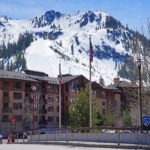
Sacramento Peak

Sacramento Peak is a forested 9,250-foot (2,819-meter) summit in the Sacramento Mountains of southern New Mexico, rising high above the Tularosa Basin and the brilliant gypsum dunes of White Sands. Although the mountain has only modest topographic prominence, it has achieved international importance for an unusual reason: for decades, its summit area has been one of the world’s notable centers for studying the Sun.
Located in Lincoln National Forest near the small community of Sunspot, Sacramento Peak occupies the dramatic western crest of the range east of Alamogordo. The terrain drops thousands of feet toward the Tularosa Basin on the west while sloping much more gradually into forested highlands to the east.
Sacramento Peak should not be confused with the highest point of the Sacramento Mountains. Current LiDAR data place the peak at approximately 9,249.7 feet, while nearby Benson Ridge and another unnamed summit rise to roughly 9,685–9,687 feet. Sacramento Peak’s significance comes instead from its location, views, forests, geology, and remarkable history of astronomical research.
⚡ Fast Facts
| Feature | Details |
|---|---|
| Mountain | Sacramento Peak |
| Country | United States |
| State | New Mexico |
| County | Otero County |
| Mountain range | Sacramento Mountains |
| Geographic province | Basin and Range / Rio Grande rift margin |
| Elevation | Approx. 9,249.7 ft / 2,819.3 m |
| Rounded elevation | 9,250 ft / 2,819 m |
| Prominence | Approx. 104 ft / 32 m |
| Key saddle | Approx. 9,146 ft / 2,788 m |
| Isolation | Approx. 0.58 mi / 0.93 km |
| Line parent | Unnamed Peak, approximately 9,685 ft |
| Nearest higher terrain | Higher Sacramento Mountains crest |
| Nearby higher named peak | Cathey Peak |
| Cathey Peak elevation | Approx. 9,641 ft / 2,939 m |
| Higher nearby summit | Benson Ridge, approx. 9,687 ft |
| Coordinates | Approx. 32.7878° N, 105.8209° W |
| Protected land | Lincoln National Forest |
| Nearby community | Sunspot |
| Closest city | Alamogordo |
| Major road | NM 6563 / Sunspot Scenic Byway |
| Famous facility | Sacramento Peak / Sunspot Solar Observatory |
| Major telescope | Richard B. Dunn Solar Telescope |
| Observatory established | Late 1940s |
| Dunn Solar Telescope completed | 1969 |
| Nearby observatory | Apache Point Observatory |
| Dominant high-elevation forest | Mixed conifer forest |
| Major western basin | Tularosa Basin |
| Nearby landmark | White Sands National Park |
The current LiDAR elevation is slightly higher than the 9,240–9,262-foot figures found in older sources. Peakbagger’s current dataset also gives Sacramento Peak approximately 104 feet of clean prominence and 0.58 mile of isolation.
🗺️ Where Is Sacramento Peak?
Sacramento Peak rises in south-central New Mexico, approximately southeast of Alamogordo and south of Cloudcroft.
It lies close to the western rim of the Sacramento Mountains, where the terrain drops dramatically toward the Tularosa Basin.
This location produces one of the mountain’s most impressive characteristics: enormous local relief.
Although Sacramento Peak itself rises only about 100 feet above its immediate saddle, the western face of the mountain range descends several thousand feet toward the desert floor.
From viewpoints along the crest, visitors can look across the Tularosa Basin toward the San Andres Mountains and the gleaming white dunes of White Sands National Park.
To the east, the landscape changes much more gradually into forested highlands.
📏 Sacramento Peak Is Not the Range High Point
The name can create an understandable misconception.
Sacramento Peak is not the highest summit of the Sacramento Mountains.
Modern LiDAR measurements place Sacramento Peak at approximately 9,250 feet.
Nearby Cathey Peak reaches approximately 9,641 feet, while Benson Ridge reaches roughly 9,687 feet. An additional unnamed high point in the southern Sacramento Mountains reaches approximately 9,685 feet.
Older descriptions sometimes treated Cathey Peak as the highest named summit of the range, while still other references included Sierra Blanca Peak in broader definitions of the Sacramento mountain region.
Modern topographic datasets make it useful to distinguish these features carefully.
Sacramento Peak’s fame therefore has relatively little to do with elevation rankings. Its scientific and geographic importance greatly exceed what its modest prominence might suggest.
📊 Prominence and Isolation
Current Peakbagger LiDAR data give Sacramento Peak approximately 103.9 feet (31.7 meters) of topographic prominence.
Its key saddle lies at roughly 9,145.8 feet.
The summit has only about 0.58 mile (0.93 kilometer) of isolation before higher terrain is reached on the surrounding Sacramento Mountains crest.
These figures reveal that Sacramento Peak is essentially a named high point along a larger elevated ridge rather than a strongly independent mountain.
ListsOfJohn uses a somewhat different topographic interpretation, giving the peak roughly 120 feet of rise and connecting its line parent to an unnamed 9,685-foot summit farther along the Sacramento Mountains crest.
Both datasets support the same larger conclusion: Sacramento Peak is topographically subordinate to higher nearby terrain.
🏔️ The Sacramento Mountains
The Sacramento Mountains extend across south-central New Mexico east of the Tularosa Basin.
The range forms a striking geographic transition between desert and high forest.
From Alamogordo, the western escarpment rises thousands of feet in only a relatively short horizontal distance. Roads climbing toward Cloudcroft quickly leave Chihuahuan Desert vegetation behind and enter pine, fir, oak, and aspen forests.
The range continues southward toward landscapes geologically connected with the Guadalupe Mountains region.
This combination of high plateaus, steep western cliffs, wooded canyons, limestone formations, caves, and desert basins makes the Sacramento Mountains one of southern New Mexico’s most diverse mountain environments.
Sacramento Peak occupies one of the range’s most recognizable high ridges.
🌎 How the Sacramento Mountains Formed
The basic structure of the Sacramento Mountains is closely connected with development of the Rio Grande rift and Basin and Range landscape.
Long before the modern mountain range formed, shallow seas covered portions of what is now southern New Mexico.
Sediments accumulated across those ancient environments and eventually hardened into limestone, sandstone, siltstone, mudstone, and evaporite deposits.
Important units in the Sacramento Mountains include the San Andres Formation and Yeso Formation, both largely Permian in age.
Much later, tectonic forces stretched the crust of the American Southwest.
Beginning tens of millions of years ago, large crustal blocks moved along faults. Some blocks subsided while neighboring blocks remained elevated or were uplifted.
The Tularosa Basin dropped relative to the Sacramento and San Andres mountains, creating the dramatic basin-and-range topography visible today.
🪨 A Mountain Built From Ancient Seafloors
Much of the upper Sacramento Mountains is underlain by sedimentary rock that originated in environments radically different from modern New Mexico.
The San Andres Limestone, which forms extensive portions of the mountain crest, records deposition in ancient marine environments during the Permian Period.
More than 250 million years ago, seas covered this region.
Marine sediments accumulated and eventually hardened into limestone.
The underlying Yeso Formation includes layers of siltstone, mudstone, carbonate rock, sandstone, and evaporite deposits.
Tectonic uplift later raised these former sea-floor sediments thousands of feet above sea level.
Today, forests and astronomical observatories stand on rock containing evidence of a time when southern New Mexico lay beneath tropical or subtropical seas.
🏜️ Overlooking the Tularosa Basin
Immediately west of Sacramento Peak lies the enormous Tularosa Basin.
The basin developed as crustal extension lowered the land between the Sacramento Mountains on the east and the San Andres Mountains on the west.
Because the basin has no natural outlet to the sea, water and dissolved minerals accumulated within it.
During wetter Ice Age conditions, a large lake known as Lake Otero occupied portions of the basin.
As the climate became drier, the lake shrank and left mineral-rich sediments behind.
Gypsum eventually accumulated, weathered into sand-sized crystals, and became the raw material for the extraordinary dune field now protected as White Sands National Park.
From the Sacramento Mountains, the bright dunes can appear almost like snow scattered across the desert floor.
☀️ Why Astronomers Chose Sacramento Peak
Sacramento Peak’s greatest claim to fame began after World War II.
Scientists and the U.S. Air Force were increasingly interested in understanding the Sun, both for basic science and because solar activity could interfere with radio communications and emerging aerospace technology.
Researchers needed a location with excellent daytime atmospheric conditions.
High elevation helps reduce the amount of atmosphere between a telescope and the Sun, while stable air and frequent clear skies improve image quality.
In 1947, scientists began evaluating Sacramento Peak as a possible observing location.
Rudy Cook spent months at the site recording weather conditions and making solar observations.
The results were encouraging enough that the mountain soon became home to a permanent solar-research facility.
🔭 Sacramento Peak Observatory
The facility became known as Sacramento Peak Observatory, or informally simply “Sac Peak.”
Its earliest years were strongly connected with the U.S. Air Force and the High Altitude Observatory.
The observatory gradually expanded as scientists realized how valuable Sacramento Peak was for solar physics.
New telescopes, housing, workshops, laboratories, and other infrastructure transformed the isolated summit into a specialized scientific community.
Research conducted there contributed to understanding sunspots, solar flares, magnetic fields, the solar chromosphere, and the relationship between the Sun and Earth’s upper atmosphere.
The small settlement associated with the observatory eventually became known as Sunspot, New Mexico.
🔬 The Richard B. Dunn Solar Telescope
Sacramento Peak’s most famous scientific instrument is the Richard B. Dunn Solar Telescope.
Originally known as the Vacuum Tower Telescope, the instrument was completed in 1969.
Its unusual structure immediately became one of the most recognizable landmarks in the Sacramento Mountains.
Much of the telescope extends underground.
Sunlight enters through the upper portion of the tower and travels through an evacuated optical system designed to reduce atmospheric turbulence inside the telescope.
The design enabled exceptionally sharp observations of small structures on the Sun.
For decades, the telescope ranked among the world’s premier instruments for high-resolution solar astronomy.
It also became an important test platform for technologies such as adaptive optics that later influenced much larger modern observatories.
🔭 Why the Telescope Used a Vacuum
Air inside an ordinary telescope can heat unevenly.
These small temperature differences create turbulence that distorts incoming light, much like the shimmering air visible above hot pavement.
For solar astronomy, where scientists may be attempting to resolve extremely small structures on the Sun, this distortion can seriously reduce image quality.
Richard B. Dunn’s telescope solved part of the problem by placing much of its optical path inside a vacuum.
Removing most of the air greatly reduced internal turbulence.
The telescope’s optical system also descended deep below ground, where temperatures remain more stable.
Its design influenced generations of later solar instruments.
🔬 A 250-Ton Telescope Floating on Mercury
One of the Dunn Solar Telescope’s most unusual engineering features was its rotating optical system.
The approximately 250-ton system was supported on a bearing containing roughly 120 gallons of liquid mercury.
Floating such an enormous structure on mercury allowed it to rotate extraordinarily smoothly.
For decades, the system performed successfully.
However, mercury is also a dangerous environmental contaminant.
In January 2026, liquid mercury was discovered inside the telescope building outside the intended containment system.
The discovery triggered a major change in the future of the observatory.
⚠️ The 2026 Closure and Observatory Restoration
As of September 2026, Sacramento Peak Observatory is closed to the public.
The closure includes the Dunn Solar Telescope, visitor center, surrounding observatory areas, and local trails directly affected by the safety zone.
The U.S. National Science Foundation announced on February 24, 2026 that it would remove the mercury, dismantle the Dunn Solar Telescope, and restore the Sacramento Peak site.
Between July 23 and August 1, 2026, crews completed drainage of the liquid mercury from the telescope.
An NSF update dated August 27, 2026 reported that mercury amalgamation had also been identified on metal surfaces within the telescope’s internal vacuum structure, adding to the complexity of remediation.
The planned removal marks the end of an extraordinary era in solar astronomy.
NSF has said it is working with local partners toward preserving the scientific legacy of the observatory through educational interpretation after remediation and restoration.
🔭 Apache Point Observatory
Sacramento Peak also lies close to Apache Point Observatory, although the two facilities should not be confused.
Apache Point is on a nearby high point approximately half a mile south of the Sacramento Peak summit area.
The site was selected during the 1980s after testing showed that the high Sacramento Mountains provided excellent conditions for nighttime astronomy as well as solar research.
Today, Apache Point operates several research telescopes, including the ARC 3.5-meter telescope and the Sloan Foundation 2.5-meter telescope.
The latter has played a central role in the Sloan Digital Sky Survey, one of the most influential astronomical mapping projects ever undertaken.
This extraordinary concentration of daytime and nighttime observatories has made the Sacramento Mountains unusually important in the history of American astronomy.
🌲 High-Elevation Forest
At approximately 9,250 feet, Sacramento Peak lies within a cool high-elevation forest environment very different from the desert below.
The Sacramento Ranger District contains extensive mixed conifer forest.
Common trees in the broader high country include white fir, Douglas fir, southwestern white pine, ponderosa pine, Colorado blue spruce, and quaking aspen.
Forest composition changes with slope aspect, moisture, elevation, and wildfire history.
Cooler and wetter locations support denser mixed-conifer communities, while warmer slopes may transition toward ponderosa pine, oak, and eventually pinyon-juniper woodland.
Driving from Alamogordo to Sacramento Peak therefore provides an unusually rapid tour through several southwestern ecological zones.
🌿 Flora and Fauna
The forests around Sacramento Peak provide habitat for a wide variety of plants and animals.
High-elevation meadows and forest openings support grasses, sedges, wildflowers, and shrubs, while shaded forest floors may contain ferns and moisture-loving herbaceous plants.
Mammals in the broader Lincoln National Forest include elk, mule deer, black bears, mountain lions, bobcats, coyotes, foxes, squirrels, and numerous smaller mammals.
Wild turkeys are common in suitable forest habitat.
Birdlife can be especially diverse because the mountains form a wooded ecological island surrounded by much drier terrain.
Raptors may soar along the escarpment, while woodpeckers, jays, nuthatches, warblers, and other forest birds occupy the conifers and deciduous woodland.
🏝️ A Southwestern Sky Island
The Sacramento Mountains function in many ways as a sky island.
A sky island is an isolated high-elevation ecosystem separated from similar mountain habitats by much warmer and drier lowlands.
From the Tularosa Basin, Sacramento Peak rises from desert terrain into forests resembling environments found much farther north.
Plants and animals adapted to cooler conditions can survive in the mountains even though surrounding lowlands may be inhospitable.
This isolation can produce unusual ecological communities and makes high-elevation forest conservation especially important.
Climate change, wildfire, drought, insects, disease, and invasive species can all place pressure on ecosystems that have limited opportunities to migrate into neighboring mountains.
🔥 Fire in the Sacramento Mountains
Wildfire is a natural and important force throughout the Sacramento Mountains.
Historically, frequent lower-intensity fires helped maintain open ponderosa pine forests and influenced the structure of mixed-conifer ecosystems.
Decades of fire suppression, changes in land use, drought, and increasing fuel accumulation have altered those patterns in many places.
The Sacramento Mountains have also experienced destructive high-intensity fires.
A major fire in 1974 burned more than 15,000 acres in the southern Sacramento Mountains and destroyed the communities of Sacramento and Weed.
Modern forest management increasingly emphasizes restoration, prescribed fire, thinning, and other methods intended to reduce the risk of catastrophic fire while maintaining healthy ecosystems.
🌦️ Weather on Sacramento Peak
Sacramento Peak’s elevation creates a much cooler climate than nearby Alamogordo.
Historical observatory weather records demonstrate that precipitation arrives through two important seasonal patterns.
Summer brings the North American monsoon, with thunderstorms particularly common during July and August.
Winter and early spring can bring Pacific storm systems producing snow, strong winds, and freezing temperatures.
Wind can be impressive.
Historical Sacramento Peak Observatory records documented occasional gusts exceeding 100 mph.
Even during summer, afternoon thunderstorms can create lightning, hail, rapid temperature drops, and dangerous conditions along exposed ridges.
Visitors should be prepared for mountain weather even when conditions on the desert floor appear hot and clear.
🥾 Hiking Around Sacramento Peak
The larger Sacramento Peak and Sunspot region connects with an extensive Forest Service trail system.
One of the best-known routes is the Rim Trail, which follows sections of the high western crest of the Sacramento Mountains.
The trail passes through forest near the edge of the dramatic western escarpment and occasionally opens to views across the Tularosa Basin.
The Forest Service describes portions of the route near Sunspot as averaging around 9,000 feet in elevation.
Several smaller connector trails also cross the area.
Under normal conditions, the high crest provides hiking, mountain biking, horseback riding, and winter recreation opportunities.
However, the immediate Sacramento Peak Observatory area and associated local trails remain closed as of September 2026 because of the ongoing mercury remediation and site-restoration project.
Visitors should consult current Lincoln National Forest information rather than relying on older trail guides.
🚗 Sunspot Scenic Byway
The Sunspot Scenic Byway, officially New Mexico Route 6563, provides the classic drive through the high Sacramento Mountains.
The paved road extends south from the Cloudcroft area toward Sunspot.
Along the way, travelers pass dense forest, high ridges, trailheads, and viewpoints overlooking the Tularosa Basin.
Under normal access conditions, the road historically terminated near Sacramento Peak Observatory.
The byway also provides access to areas near Apache Point Observatory and various forest roads and trails.
Because of the current Sacramento Peak Observatory closure, travelers should check road and destination restrictions before assuming that the observatory grounds themselves are accessible.
🌄 Views Toward White Sands
One of the greatest rewards of visiting the western Sacramento Mountains is the view across the Tularosa Basin.
From suitable overlooks, White Sands National Park appears as a brilliant white patch more than 4,000 feet below the high mountain crest.
The contrast is extraordinary.
Forested ridges in the foreground give way to broad desert plains, gypsum dunes, dry lakebeds, military lands, and the distant San Andres Mountains.
The same geography that creates these views also explains Sacramento Peak’s value for astronomy.
The steep western escarpment places the summit far above much of the surrounding lowland atmosphere.
🏔️ Nearby Mountains
Cathey Peak rises northeast of Sacramento Peak to approximately 9,641 feet. It is one of the highest named summits in this portion of the Sacramento Mountains.
Benson Ridge reaches approximately 9,687 feet and current LiDAR data identify it as one of the highest points in the Sacramento Mountains proper.
An Unnamed Peak nearby reaches approximately 9,685 feet and is associated with Sacramento Peak’s broader topographic parentage.
Farther north, Sierra Blanca Peak rises to nearly 12,000 feet and dominates the greater south-central New Mexico mountain skyline.
To the southwest, Organ Needle rises above the Organ Mountains. Despite being lower than Sacramento Peak, its enormous prominence and steep rocky architecture give it a much more dramatic independent profile.
Farther southeast, the Guadalupe Mountains continue the remarkable sequence of elevated limestone terrain found across southern New Mexico and West Texas.
🔭 A Mountain That Changed Solar Astronomy
Sacramento Peak’s physical summit is not particularly prominent.
At barely more than 100 feet of topographic prominence, it would normally receive little attention outside local maps.
Yet geography placed the mountain in exactly the right location for science.
High elevation, relatively dry air, clear skies, good atmospheric seeing, and proximity to White Sands missile research led scientists to establish Sacramento Peak Observatory in the late 1940s.
The instruments built there subsequently influenced solar astronomy for generations.
The Dunn Solar Telescope became one of the world’s great solar-research instruments and helped pioneer techniques and technologies eventually incorporated into newer observatories.
Nearby Apache Point extended the area’s astronomical importance into nighttime research.
🌄 Why Sacramento Peak Stands Out
Sacramento Peak demonstrates that a mountain’s importance cannot always be measured through elevation or prominence.
It is not the highest summit of the Sacramento Mountains, nor is it a major independent peak.
Modern LiDAR gives it only about 104 feet of prominence.
Yet few mountains of comparable size have played such an important role in astronomy.
Its summit became a laboratory for understanding the Sun. Scientists there studied solar magnetic fields, flares, sunspots, and atmospheric structures while developing technologies that influenced the next generations of telescopes.
The mountain is equally fascinating from a natural perspective.
Ancient marine limestone sits thousands of feet above the desert. Basin-and-range faulting created a dramatic western escarpment. Mixed-conifer forest occupies the cool summit while White Sands gleams far below.
As the historic Sacramento Peak Observatory enters a new chapter following its 2026 closure and planned restoration, the mountain remains an unusual meeting point of geology, forests, desert scenery, human ingenuity, and the science of our nearest star.
🔗 Related Articles
- Sacramento Mountains
- Mountain Ranges in the U.S.
- Guadalupe Peak
- Best Hikes in Guadalupe Mountains National Park
📚 Sources
- Peakbagger — Sacramento Peak
- ListsOfJohn — Sacramento Peak
- ListsOfJohn — Otero County Peaks and LiDAR Elevations
- U.S. National Science Foundation — Sacramento Peak Observatory Closure and Site Restoration
- U.S. National Science Foundation — Sacramento Peak Observatory Update, August 27, 2026
- National Solar Observatory — Dunn Solar Telescope: A 50 Year Retrospective
- New Mexico State University — History of Sunspot Solar Observatory
- New Mexico State University — Sunspot Observatory Access Status
- Apache Point Observatory — Official Observatory Information
- U.S. Forest Service — Lincoln National Forest
- U.S. Forest Service — Sacramento Mountains Forest Reference Conditions
- National Park Service — Geology of White Sands and the Tularosa Basin
- New Mexico Geological Society — Southern Sacramento Mountains Geology