
Aiguille du Dru (Dru, the Drus, Les Drus)

Rising dramatically above the Chamonix Valley in the French Alps, Aiguille du Dru is one of the most recognizable rock towers in the entire Mont Blanc massif. Often called simply the Dru or Les Drus, the mountain is famous for its steep granite walls, twin summits, extraordinary climbing history, and the enormous rockfalls that have repeatedly reshaped its western face.
The mountain stands immediately west of Aiguille Verte and forms part of the spectacular skyline surrounding Chamonix. Although considerably lower than nearby Mont Blanc, the Dru has played an outsized role in the history of technical alpine climbing. Its near-vertical faces became proving grounds for some of the greatest climbers of the 19th and 20th centuries, including Clinton Thomas Dent, Alexander Burgener, Pierre Allain, Walter Bonatti, Royal Robbins, and Gary Hemming.
Today, Aiguille du Dru remains a serious mountaineering objective rather than a conventional hiking summit. Its long routes, complex descents, glaciers, rapidly changing conditions, and significant rockfall hazard demand extensive alpine experience.
⚡ Fast Facts
| Feature | Details |
|---|---|
| Mountain | Aiguille du Dru |
| Also Known As | The Dru, Les Drus |
| Country | France |
| Region | Auvergne-Rhône-Alpes |
| Department | Haute-Savoie |
| Mountain Range | Mont Blanc massif, Graian Alps |
| Highest Summit | Grand Dru |
| Elevation | Approximately 12,316 feet / 3,754 meters |
| Prominence | Approximately 640 feet / 195 meters |
| Isolation | Approximately 0.32 miles / 0.51 kilometers |
| Nearest Higher Neighbor | Aiguille Verte |
| Petit Dru Elevation | Approximately 12,247 feet / 3,733 meters |
| Rock Type | Primarily granite |
| First Ascent of Grand Dru | September 12, 1878 |
| First Ascenders | Clinton Thomas Dent, James Walker Hartley, Alexander Burgener, and Kaspar Maurer |
| First Ascent of Petit Dru | August 29, 1879 |
| Famous Climbing Feature | West Face and former Bonatti Pillar |
| Nearest Major Town | Chamonix-Mont-Blanc |
| Best Known For | Technical alpine climbing, dramatic granite walls, and mountaineering history |
🏔️ A Mountain with Two Summits
Aiguille du Dru is actually composed of two closely spaced summits. The Grand Dru, at approximately 3,754 meters, is the higher eastern summit. Immediately beside it stands the Petit Dru, at about 3,733 meters. The two are separated by the narrow Brèche du Dru, a high notch in the ridge.
Together they form part of the western ridge extending from Aiguille Verte. Their steep profiles are particularly striking when viewed from the Chamonix Valley and the Mer de Glace area.
Although the Grand Dru is slightly higher, the Petit Dru became especially famous among climbers because of its massive west and southwest faces. These walls rise roughly 1,000 meters and contain some of the most historically important technical routes in the Alps.
The Dru belongs to the same remarkable concentration of granite needles and summits that includes Aiguille du Grépon, Aiguille du Moine, Aiguille Sans Nom, Aiguille Verte, and the more distant Grandes Jorasses.

🪨 Geology of Aiguille du Dru
The spectacular appearance of Aiguille du Dru is closely connected to the geology of the Mont Blanc massif. Granite dominates much of the massif, producing the sharp ridges, vertical walls, towers, and slender aiguilles for which the Chamonix region is famous.
Repeated glaciation played an equally important role in shaping the mountain. Over successive ice ages, glaciers carved deeply into the surrounding landscape while frost, flowing water, and freeze-thaw cycles widened cracks in the exposed rock.
This combination of resistant granite and intense alpine erosion helped produce the Dru’s extraordinarily steep profile. The same forces continue to reshape it today.
At such elevations, rock is exposed to extreme temperature fluctuations. Water entering fractures can freeze and expand, gradually weakening the mountain. Warming conditions and thawing of ice within rock fractures may further destabilize steep alpine walls, making rockfall an especially important concern on the Dru.
🧗 The First Ascent of the Grand Dru
The first successful ascent of the Grand Dru took place on September 12, 1878, when British mountaineers Clinton Thomas Dent and James Walker Hartley reached the summit with guides Alexander Burgener and Kaspar Maurer.
Their route climbed the mountain’s southeastern side and represented a remarkable achievement for the period. Unlike many early Alpine ascents that relied heavily on snowfields and glaciers, climbing the Dru required sustained movement across steep rock.
That difference helped make the ascent an important milestone in the transition toward modern technical mountaineering.
Dent later described the Dru as an unusually continuous rock climb. The mountain required climbers to use their hands almost immediately after leaving the glacier, something that was considerably more unusual in the mountaineering world of the late 19th century than it is today.

🧗♀️ The First Ascent of the Petit Dru
The slightly lower Petit Dru proved even more difficult.
Its first ascent was completed on August 29, 1879, by Jean Charlet-Straton, Prosper Payot, and Frédéric Folliguet. Their climb followed the south face and southwest ridge.
The ascents of both Drus helped establish Chamonix as a center not simply for reaching high summits, but for increasingly technical rock climbing. This evolution would continue on nearby mountains such as Aiguille du Grépon, where climbers began deliberately seeking elegant and difficult lines rather than simply the easiest route to a summit.
The eventual traverse between the two summits became another classic alpine challenge, combining exposed rock climbing, complex route-finding, and high-altitude terrain.
🧗 The Legendary West Face
Few walls in European mountaineering possess the reputation of the west face of the Petit Dru.
Rising approximately 1,000 meters above the surrounding glaciers, the wall appears extraordinarily steep from the Chamonix side of the massif. For decades it was regarded as one of the great unsolved climbing problems of the Alps.
Pierre Allain and Raymond Leininger made the first ascent of the Petit Dru’s north face in 1935. At the time, the enormous western wall still appeared close to impossible.
That perception finally changed in 1952, when a team including Lucien Bérardini, Adrien Dagory, Guido Magnone, and Marcel Lainé completed the first route through the west face after multiple attempts.
Their achievement opened an entirely new chapter in the mountain’s history.
🧗♂️ Walter Bonatti and the Bonatti Pillar
The Dru became permanently linked with legendary Italian climber Walter Bonatti in 1955.
Over six days in August of that year, Bonatti climbed a new route alone on the southwest pillar of the Petit Dru. The resulting line became known as the Bonatti Pillar and was regarded as one of the most extraordinary solo climbing achievements of its era.
Bonatti’s ascent represented more than the completion of another difficult route. It demonstrated what a single highly skilled climber could accomplish on an enormous alpine wall with relatively primitive equipment by modern standards.
The pillar subsequently became one of the most famous features in European climbing.
But it would not remain intact forever.
💥 The Rockfalls That Changed the Dru
Aiguille du Dru provides a dramatic example of how mountains continue to evolve.
Large rockfalls have repeatedly occurred on its western and southwestern faces, including significant events in 1950, 1997, 2003, 2005, and 2011. These collapses altered or completely destroyed established climbing routes.
The most famous occurred in 2005, when a massive section of the southwest face collapsed. The event destroyed the original Bonatti Pillar and erased much of Bonatti’s historic route.
The pale rock scar left behind remains clearly visible.
For climbers, the rockfalls are more than geological curiosities. They demonstrate why route descriptions on extremely steep alpine mountains cannot always be treated as permanent. A climb that existed for decades can change dramatically—or disappear altogether.

🧭 Climbing Aiguille du Dru Today
Aiguille du Dru remains firmly within the realm of serious alpine mountaineering. There is no hiking trail to the summit, and even the traditional routes involve steep rock climbing, glacier travel, route-finding, rappels, and long periods of exposure.
One of the classic objectives is the traverse of the Drus, traditionally approached from the Refuge de la Charpoua. The route combines crack and chimney climbing with complex alpine terrain and can involve difficulties around 5c depending on the exact line and conditions.
The climbing itself represents only part of the challenge. Alpinists must also negotiate glacier terrain, changing snow conditions, potentially unstable rock, complicated descents, and rapidly shifting mountain weather.
Climbers considering the Dru should have significant experience with multi-pitch rock climbing, alpine rope systems, glacier travel, rappelling, navigation, and emergency decision-making. Many visitors choose to climb with a qualified high-mountain guide.
🛖 Refuge de la Charpoua
The Refuge de la Charpoua, situated at roughly 2,841 meters, is one of the traditional bases for climbing the Drus.
The small high-mountain refuge sits in the Charpoua cirque near the foot of Aiguille du Dru and Aiguille Verte. Reaching it is itself a substantial mountain journey rather than a casual hut walk.
Access traditionally begins around Montenvers and the Mer de Glace before continuing through rugged alpine terrain toward the refuge.
Its location places climbers remarkably close to some of the most famous granite walls in the Mont Blanc massif, including the Drus, Aiguille Sans Nom, and Aiguille Verte.
⚠️ Hazards and Safety
Rockfall is one of the defining hazards on Aiguille du Dru. The repeated collapses of the west face demonstrate the instability that can affect steep high-alpine rock.
Other hazards include glacier crevasses, bergschrunds, icefall, loose stone, storms, lightning, sudden temperature changes, altitude, and difficult retreat once committed to a long route.
Conditions can also vary dramatically from one season to another. A route that is relatively dry and stable during one period may contain ice, snow, or active rockfall during another.
Current route information, recent climber reports, professional local advice, and weather forecasts are therefore particularly important when planning an ascent.
A helmet, appropriate technical climbing equipment, glacier gear where required, emergency communication equipment, and a conservative approach to weather and objective hazards are essential.
🌿 Flora and Fauna
Little vascular plant life survives on the highest rock walls of Aiguille du Dru itself. At elevations approaching 3,800 meters, conditions are dominated by exposed stone, snow, ice, wind, and extreme temperature changes.
Lower elevations around the Mont Blanc massif support much richer alpine ecosystems. Lichens, mosses, saxifrages, gentians, alpine grasses, and other cold-adapted plants occupy rocky slopes and alpine meadows where sufficient soil and moisture are available.
Descending farther toward the Chamonix Valley brings forests containing species such as larch and spruce, creating a dramatic transition from wooded mountain valleys to almost completely barren high-alpine rock.
Wildlife within the wider Mont Blanc region includes Alpine ibex, chamois, Alpine marmots, mountain hares, red deer, rock ptarmigan, and black grouse. Golden eagles and bearded vultures may also be seen in parts of the Alps.
Most animals remain well below the exposed summit of the Dru, but the surrounding slopes and valleys form part of a remarkably diverse mountain ecosystem.
👀 Where to See Aiguille du Dru
Fortunately, appreciating Aiguille du Dru does not require climbing it.
The mountain’s distinctive silhouette can be seen from several locations around the Chamonix Valley, particularly near Les Praz and viewpoints toward the Mont Blanc massif.
The Montenvers and Mer de Glace area also provides dramatic perspectives on the surrounding granite peaks. From suitable viewpoints, the relationship between the Dru, Aiguille Verte, glaciers, and neighboring aiguilles becomes much easier to understand.
These lower viewpoints allow visitors to appreciate one of the Alps’ great climbing mountains without entering its dangerous technical terrain.
🏔️ Nearby Mountains
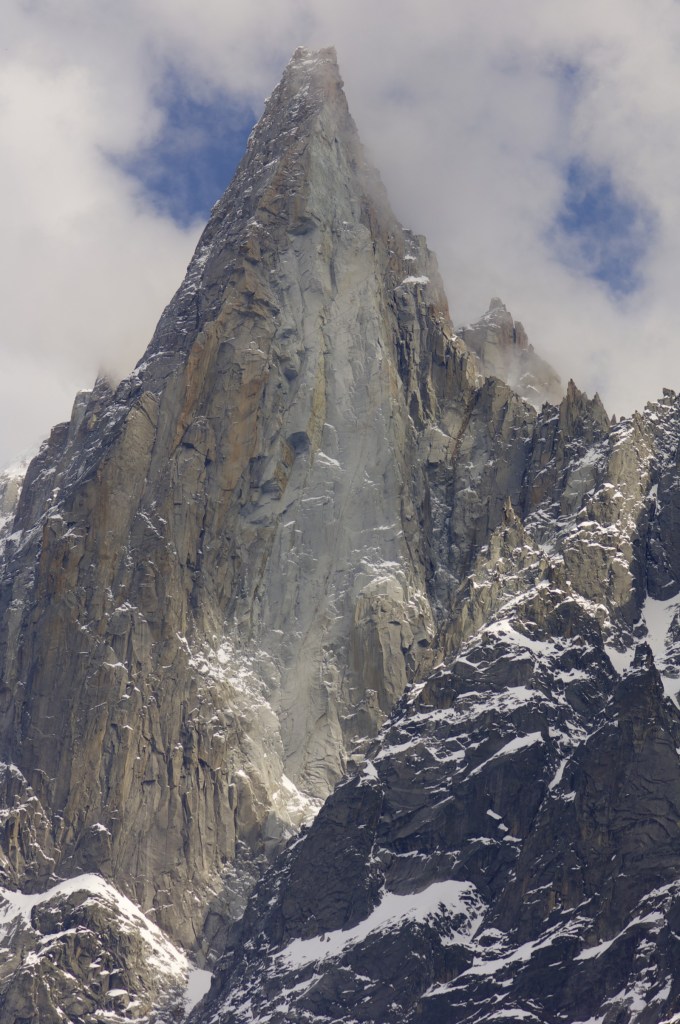
Aiguille du Dru occupies one of the most spectacular mountain neighborhoods in Europe.
Immediately east stands Aiguille Verte, the 4,122-meter summit from whose western ridge the Drus rise. Nearby granite towers include Aiguille Sans Nom and Aiguille du Moine.
Farther across the Mont Blanc massif are Aiguille du Grépon and the other famous Aiguilles de Chamonix.
The immense Grandes Jorasses rise farther east along the French-Italian frontier, while Mont Blanc dominates the massif to the southwest.
Together these peaks make the Chamonix region one of the world’s greatest concentrations of historically significant alpine mountains.
🌄 Why Aiguille du Dru Matters
Aiguille du Dru is not among the highest mountains in the Alps, yet elevation alone does little to explain its importance.
Its extraordinary granite walls became laboratories for generations of climbers searching for increasingly difficult, direct, and elegant routes. The first ascents of the Grand Dru and Petit Dru helped redefine what mountaineering could be. Later accomplishments on its west face pushed technical climbing even further.
The mountain has also provided a powerful reminder that even apparently permanent landmarks are continually changing. Rockfalls have erased celebrated routes, destroyed major sections of cliff, and forced each generation of climbers to encounter a somewhat different mountain.
For anyone interested in the history of alpinism, Aiguille du Dru stands alongside the most important climbing peaks of Europe—a slender granite tower whose influence reaches far beyond its 3,754-meter summit.

🔗 Related Articles
📚 Sources
- Peakbagger — Aiguille du Dru
- Compagnie des Guides de Chamonix — The Drus: A Legendary Summit
- Compagnie des Guides de Chamonix — Les Drus
- Larousse — Aiguille du Dru
- Refuge de la Charpoua
- ATLAS Mont-Blanc — Wild Mont-Blanc




